

'Raiders of the Lost Ark' Shows Exactly How To Steal Like An Artist
For their first professional outing, George Lucas and Steven Spielberg borrowed from everything they loved to craft a B-movie with A-list qualities.

In 2023, Indiana Jones and the Dial of Destiny flopped at the box office.
What in the world happened?
Because when Steven Spielberg, who had directed every Indiana Jones film until then, decided not to direct the fifth film, it’s not like Lucasfilm hired just anyone to replace him. They picked James Mangold. They got a good crew and cast—Phoebe Waller-Bridge! Mads Mikkelsen! Toby Jones! Antonio Banderas!
Plus, you know… it was Indiana Jones! Every other installment had either been the highest-grossing film of the year (the first and third) or in the top three (the second and the fourth).
Was it because the film was too expensive to make?1 Was it because the franchise’s creators, George Lucas and Steven Spielberg, weren’t involved? Or was it because the world had moved on from Indiana Jones?
Here’s my theory.
I think George Lucas and Steven Spielberg made it look really easy to pull off the Indiana Jones films. I’d also like to point out that even though the pair made four of these films together, it’s the first one— Raiders of the Lost Ark— that’s still held up as the gold standard.
So it’s not as if they were able to repeat the magic to maximum effect each time, either.
Raiders of the Lost Ark celebrates its 45th anniversary this year— it came out on June 12 1981— which makes it the perfect time to go back in time to explore the franchise’s origins, and what you can learn about channeling the things you love into your films.
Indiana Jones came to George Lucas while he was stuck brainstorming ideas for Star Wars, his mind drifting towards serials he used to enjoy as a child. This one in particular was called Don Winslow of the Navy (1942), about a serviceman who fought the Nazis. When he wasn’t thinking about a galaxy far, far away, Lucas imagined an archaeologist in a leather jacket and felt fedora, carrying a bullwhip and running around the globe seeking ancient treasures. Hey, maybe there was something in this idea and this character… his name?
Indiana Smith. Named after his beloved Alaskan Malamute, Lucas actually tried to make it before Star Wars, pitching the idea to filmmaker Philip Kaufman (The White Dawn, Invasion of the Body Snatchers). When Lucas confessed he didn’t know what the MacGuffin treasure would be, Kaufman proposed the Lost Ark of the Covenant, a story he’d originally heard from his dentist in Chicago. The two kicked the idea around but then Clint Eastwood hired Kaufman to work on the script for The Outlaw Josey Wales.
In 1977, George Lucas was hiding out in Hawaii and avoiding the world’s reaction to Star Wars. Steven Spielberg joined him, and the two were building sandcastles on the beach when Lucas asked his friend what he wanted to make next. Spielberg, who was still in post-production on Close Encounters of the Third Kind, wanted to direct James Bond.
Lucas had something better than Bond: a dashing college archaeology professor and part-time treasure hunter…
Spielberg was hooked. He wanted to direct it.
But Raiders would have to wait. George Lucas returned to Star Wars— partly because it was in his contract to get a sequel out within two years or let the rights revert to Fox, which didn’t sit well with him— and Spielberg went to make 1941.
It’s a funny thing. If Spielberg had not made 1941, he’d have had a rare four-film run—Jaws, Close Encounters of the Third Kind, Raiders of the Lost Ark, and E.T.: The Extra-Terrestrial. Yet 1941 was absolutely critical because…
Raiders of the Lost Ark was Spielberg’s chance to prove he could make a film on time and budget
Despite the box-office success and acclaim of Jaws and Close Encounters of the Third Kind, Spielberg had developed a reputation for running over budget and over schedule. When 1941 stumbled— it wasn’t a flop, but audiences were muted and the film was a modest success— executives realized that Spielberg did not have the Midas touch. Even a Spielberg film could take a hit.
So when Lucas went around pitching Raiders of the Lost Ark, studios balked at Spielberg as director because they didn’t have confidence in his ability to keep it under control. But Lucas didn’t budge. Raiders was a package deal: Spielberg as director, Lucas as producer. Take it or leave it.
“I was committed to Steven,” recalls Lucas. “We’d had a long talk about how we were going to make the movie. I trusted Steven. He had directed television. He knew how to do what had to be done.”
For Spielberg, Raiders was a chance to prove he could be trusted. He’d later describe the opportunity as a “film to clean out my system, [to] blow the saliva out of my mouthpiece.”
Lucas advised his friend to shoot the film as if it was an old movie serial— “quick and dirty,” he described it. When Paramount Pictures finally picked up the deal, they told that the film would take 85 days to make. In reality, Spielberg, Lucas, and producer Frank Marshall had secretly drawn up another schedule that allowed them to shoot Raiders within 73 days in. Plus, if the studio inquired about progress, Lucas could tell them that they were ahead of schedule.
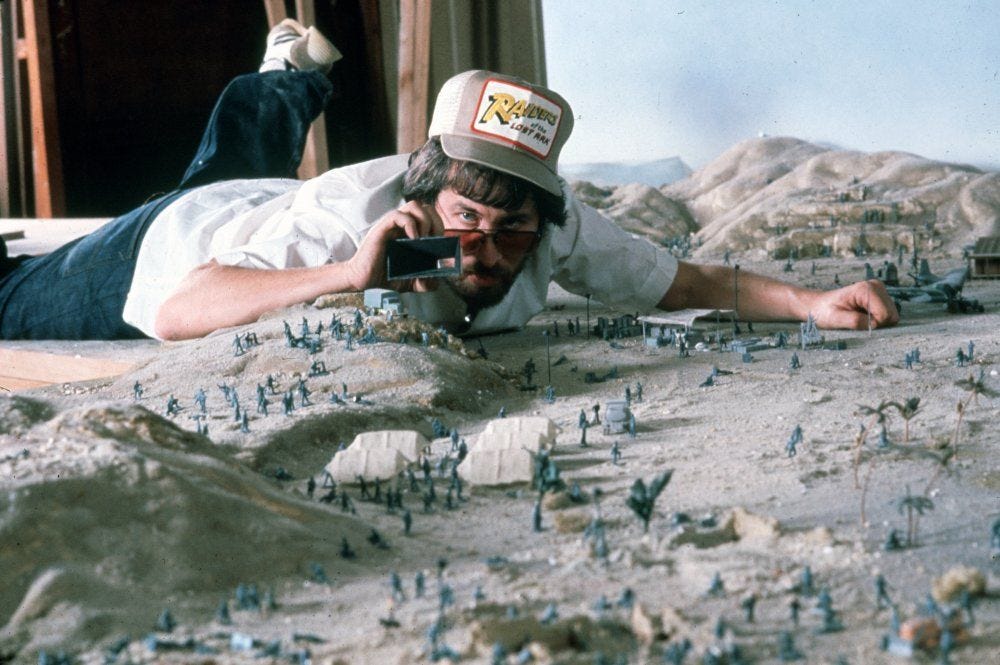
So to plan himself as much as possible, Spielberg hired four illustrators to storyboard about 80% of the film—to which he kept to about 60%. He also had the art department build model scales for each set, allowing Spielberg to “keep the cost to its ground” while letting him to figure out where to place the camera to shoot his scenes. According to producer Frank Marshall, this resulted in an astonishing 50 setups daily— twice the usual amount of setups done on a film this scale.
Time—and money—was also saved when they removed planned scenes. This included swapping montages showing Indiana traveling from one country to the next with a map of the world and little animated lines tracing his route— a device used in several old films, including Casablanca; one of several films to pay tribute for inspiring Raiders.
Speaking of inspirations…
Raiders of the Lost Ark borrowed from everything that Lucas and Spielberg loved
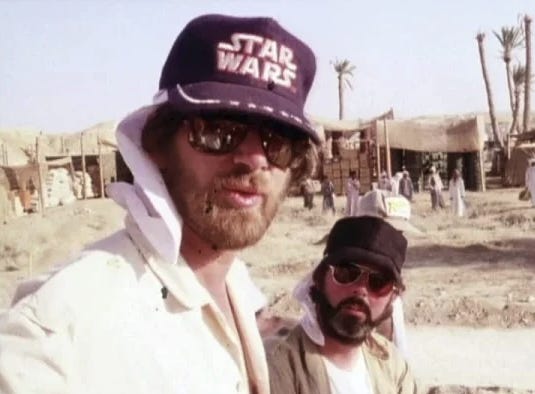
Just like its treasure-hunting protagonist, Lucas and Spielberg pilfered from all the movies, serials, and comic books that they loved, and threw it into the Raiders blender, just as Lucas did with Star Wars.
The film wore its B-movie aspirations on its sleeve unabashedly, but it was heightened with references to everything— for instance, Indiana Jones was modeled after Humphrey Bogart’s grizzled gold digger character in John Huston’s The Treasure of the Sierra Madre, and his wardrobe lifted from the Charlton Heston 1954 vehicle Secret of the Incas; the opening sequence was influenced by the pre-title sequences in James Bond in which Bond is engaged in something that rarely has to do with the main plot2, as well as Scrooge McDuck (yep, the boulder sequence borrowed from the Carl Barks’s Disney comic); while Indy’s outfit when he’s channeling a shaft of sunlight to find the location of the Lost Ark is a near-identical replica of T.E. Lawrence’s Bedouin garb from Lawrence of Arabia. Other influences ranged from Gunga Din, Stagecoach, Seven Samurai, The Great Escape, and Red River.
The Republic serials from the 1930s and 1940s were crucial to the structure of the story. These types of movies would end in a cliffhanger to induce theatergoers to return next week to see what happened. Those stories migrated to television, which was how a young Lucas and Spielberg would have watched them. Lucas wanted Raiders to mimic that structure of bingeing serials such as Buck Rogers or Flash Gordon, with some kind of death-defying moment every 10 to 20 minutes. When he structured the outline, Lucas would divide the story into 60 scenes. Each scene was two pages long, with six cliffhangers; and every twenty pages, the hero gets into a dangerous situation and had to use his cleverness and resourcefulness to get out.
To prepare for Raiders, Lucas and Spielberg actually sat down to rewatch all fifteen episodes of Don Winslow of the Navy. What they realized is that modern audiences had become more sophisticated and would never accept Raiders replicating Don Winslow. Instead, Lucas and Spielberg had to use the serials as a starting point to create something original.
There was another influence that would prove crucial to the success of Raiders, but it would come from an outside source…
How Lawrence Kasdan channeled 1930s-1940s screwball comedies and romances into Raiders of the Lost Ark
It was Steven Spielberg who roped Lawrence Kasdan to script Raiders of the Lost Ark; which also got him hired to write Star Wars: The Empire Strikes Back. The former advertising copywriter had impressed Spielberg with a romantic comedy script called Continental Divide, and he sat with Lucas and Spielberg, the trio brainstorming over many days while working off Lucas’s twenty-three-page handwritten story treatment.
Just as Lucas and Spielberg channeled the things they loved, Kasdan loved screwball comedies and noir films from the 1930s and 1940s, especially the banter between the leads, and he would inject this into Raiders. Kasdan says:
I took pride in the relationship part of [Indiana Jones and Marion Ravenwood]. It was all comedy character stuff, Cary Grant-Jean Arthur stuff. There’s about three times as much that didn’t get used. They just simplified the whole thing. When I look at the movie now, I think that they were right.
Apart from the banter, these films from the 1930s and 1940s had richly drawn supporting actors, and this was something that Kasdan was determined to do with Raiders. He elaborates:
I didn’t want it to be just about the leads. The movies I loved from the ‘30s and ‘40s were rich with supporting characters. So even though some of them may only be on for three lines, they have to be a good three lines. Belloq always has good stuff to say.
That influence is REALLY hard to mimic. It’s even hard to find a writer that loves those as much as Kasdan, or at least enough to replicate it in their style. I’m not disparaging the sequels, but that touch of comedic flair and romance is missing in the sequels— the same touch that Kasdan brought The Empire Strikes Back— and this might be the secret ingredient to the success of Raiders more than anything else.
But for this to work, the main character needed to be exciting. Luckily, Indiana Jones was all that and more…
The appeal (and dark side) of Indiana Jones as a hero
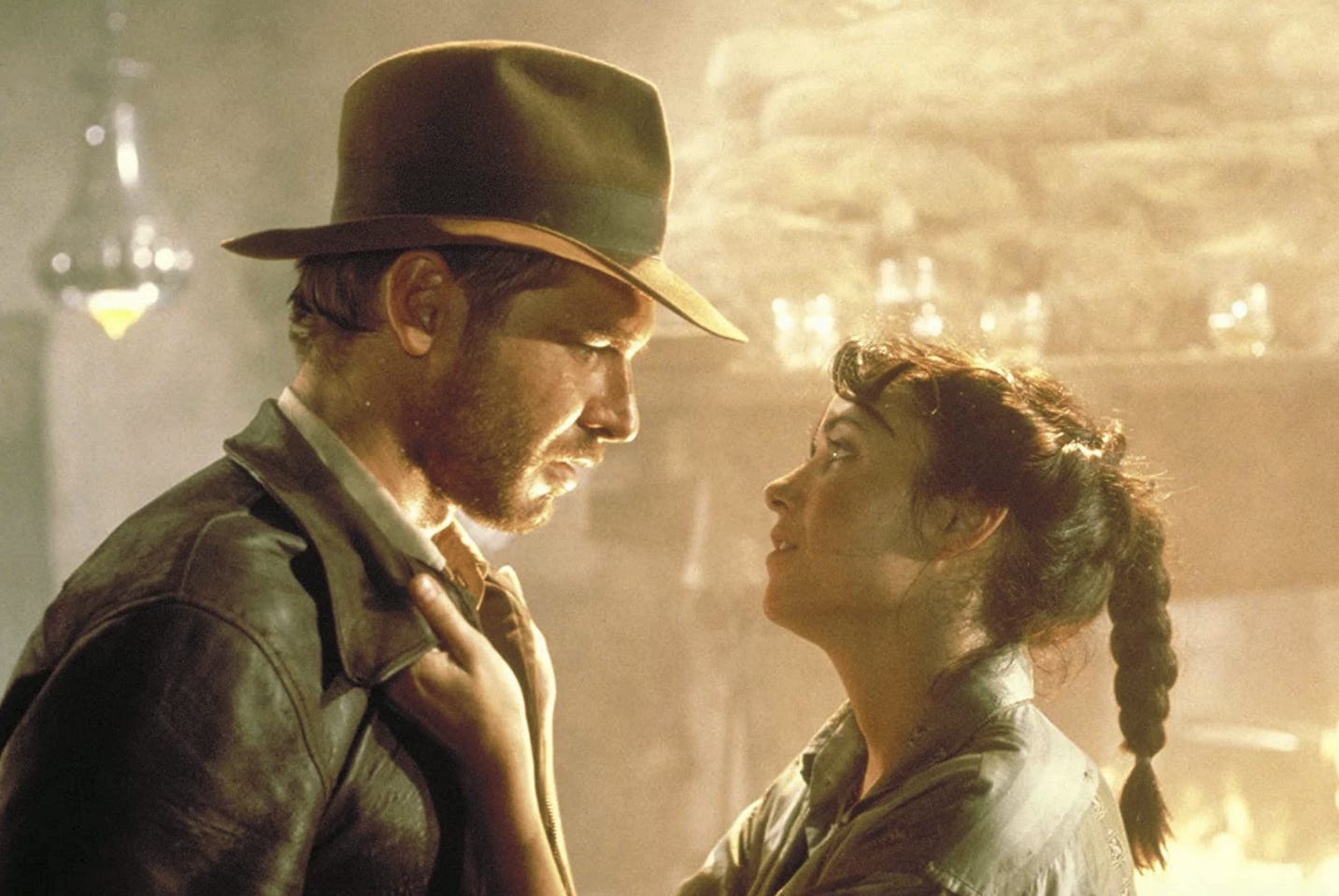
One big change made was the character’s name. Steven Spielberg disliked ‘Indiana Smith’ because it reminded him of the 1966 Steve McQueen western Nevada Smith. Lucas, who only wished the main character to have a quintessentially American name, simply changed it to ‘Indiana Jones’.
While Lucas and Spielberg were more or less united in their vision of what the film should be, they clashed over the character’s personality.
Lucas envisioned Indiana Jones as a James Bond-eque playboy who funded his lifestyle through his treasure-hunting expeditions— a third draft dated August 1979 actually features an alternate version of the scene in which Marcus Brody visits Indy before he sets off for Nepal.
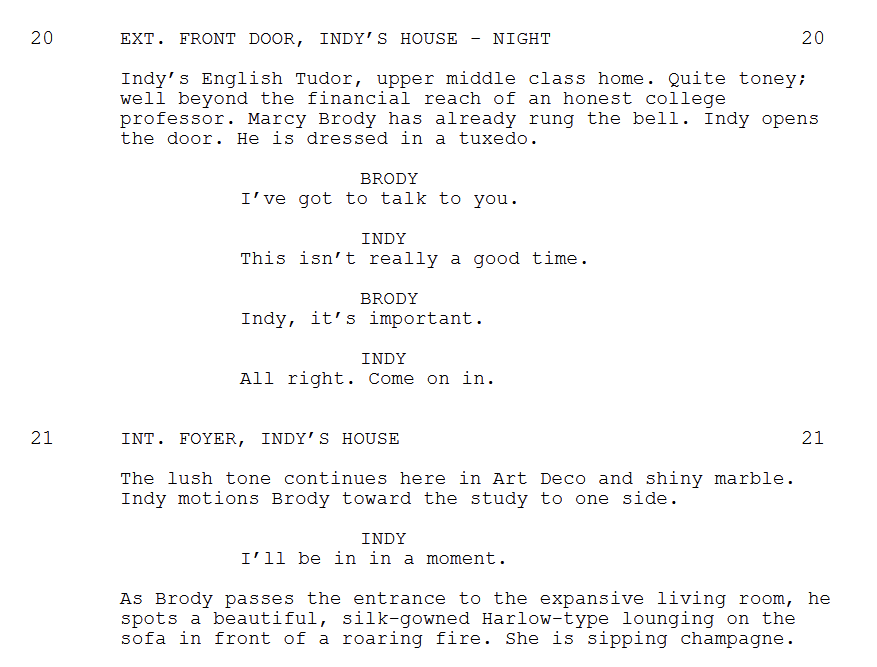
But Spielberg and Kasdan both believed that Indy as professor and adventurer was complicated enough without throwing in a playboy side. For his part, Spielberg wanted to make Indy an alcoholic like Fred C. Dobbs, Bogart’s character in The Treasure of the Sierra Madre, but Lucas vehemently opposed that: he wanted Indiana Jones to be a role model for kids.
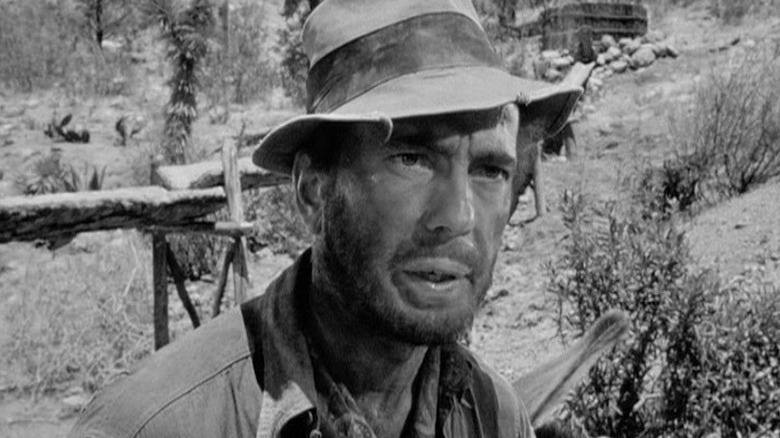
In the end, they compromised: Indy would be neither a playboy nor an alcoholic.
But something that often gets omitted in discussions is that despite Lucas’s noble intentions of Indiana Jones as a role model, the character is almost a monster. ESPECIALLY when you learn that he seduced Marion Ravenwood when she was fifteen while he was most likely in his early- to mid-20s. In fact, this darkness is pointed out by Indy’s rival archaeologist, René Belloq, who observes that the hero is not so different from him as he’d like to believe: “It would take only a nudge to make you like me—to push you out of the light.”
So why is the Indy-Marion romance palatable despite that? The trick is that even as the attraction builds, it never actually leads to anything sultry. When Marion does finally kiss him as they hide on a tramp steamer, Indy actually falls asleep, wiped out from all the events. Really not sure what Lucas and Spielberg were thinking of when they made out that Indy seduced a teenager but oh well…
Like Bond, Indiana Jones has a dry sense of humor that makes him endearing. He’s also a flawed character— his treasure hunts are morally dubious3, and we mentioned the Marion stuff— but he’s also real— he has a great fear of snakes, like many people do. And unlike Bond, who has that unfazed attitude that he’s always on top of the situation no matter, Indy is always overmatched— from the moment he attempts to steal the idol in the opening— but he perseveres. He doesn’t have a plan, but damn if he doesn’t just keep on going. “I don’t know, I’m making this up as I go,” Indy grumbles memorably right before he jumps into action.
And when Harrison Ford was cast, he added a little bit of his own personality to give Indiana Jones the right mix of vitality and vulnerability.
If there was any doubt about Indiana Jones’s moral dubiety, here’s Lawrence Kasdan stating it for the record:
Indy’s a classic anti-hero (emphasis mine). The idea always from the get-go was that he’s fallen from grace as an archaeologist and he’s become a grave robber.
Above all, however, it did not, as Kasdan said, “take itself too seriously.” The Dial of Destiny could have paid heed to this and avoided making it too serious.
What people get wrong about Indiana Jones
George Lucas once said: “People have tried to do what we did, but they don’t understand the humour of it. They don’t understand the action and they don’t understand the MacGuffin.”
I think he’s right.
The list of Indiana Jones imitators is too many to note down— the better ones are Robert Zemeckis’s Romancing the Stone and Stephen Sommers’s The Mummy and National Treasure, as well as the Tomb Raider and Uncharted video games— but none of them really match the heights of Raiders. Including the Indiana Jones sequels.
One of the other things that Raiders did so well was that everything in it resonated from other movies. But when they threw in everything into that first film, it became increasingly difficult to find new sources to draw from for future stories.
Lucas always thought that the franchise was a good vehicle to test different genres as long as it involved Indiana Jones looking for an artifact with an archaeological or historical background and a believable MacGuffin. Turns out it wasn’t that easy— Indiana Jones and the Temple of Doom wasn’t liked as much, and the same went for The Kingdom of the Crystal Skull (paying homage to 1950s sci-fi B-movies with aliens) Even The Last Crusade rehashed Raiders both with another Biblical artifact (the Holy Grail) and the same villains (Nazis)— the biggest difference was that in this film, more attention was paid to the relationship between Indiana Jones and his father (Sean Connery) than the treasure hunt.
The other problem was the budget. The success of Raiders meant that subsequent films became more expensive— especially as the stars of Spielberg, Lucas, and Harrison Ford all rose during the 1980s. What’s ironic is that Raiders WAS made in such a way to mimic shooting an “old-school serial”, made fast and comparatively cheaply.
This might explain why The Dial of Destiny flopped. It was way too expensive, and instead of taking influences from other films, it borrowed from the Indiana Jones franchise itself— especially Raiders. In an article, a writer points out:
[In Dial of Destiny], we no longer see references to movies made before Star Wars; instead, the new film, directed and co-written by James Mangold, is an homage to the other Indiana Jones flicks, with Mads Mikkelsen’s baddie at one point jacking his whole outfit from Raiders’ Arnold Toht and, at another, donning René Belloq’s white suit and fedora. John Rhys-Davies reprises not just his role as Indy’s faithful counselor Sallah but the few bars of H.M.S. Pinafore he bellows at the end of the original film. Indy and Marion Ravenwood (Karen Allen), on the outs at the beginning of Dial, reenact Raiders’ “Where does it hurt?” scene right before the camera discreetly gives them some privacy as the film ends. And that scene in which a sunbeam reveals the location of the titular relic is back, except this time to nod to Raiders rather than to shine a light on a forgotten Charlton Heston vehicle.
I mentioned this point in an earlier article I wrote about Star Wars, and how the Disney-era sequel films— save for The Last Jedi— didn’t bring in any outside influences apart from the Star Wars franchise itself, and why that’s never a good thing. Specifically, I wrote:
“…creativity is about taking different elements from different stories and mixing them into something new… but if a film takes elements from the very source of its creation without bringing in anything new, the result is a sense of a snake eating its own tail— an ouroboros [which] defeats the purpose of creativity.”
The original Raiders recipe— keeping the film’s budget on the low side, throwing in all the references that Lucas and Spielberg could think of, and Lawrence Kasdan’s scriptwriting abilities— was never replicated for us to determine if that was the correct mix that made Raiders work as well as it did. What we do know is that the broader your creative influences, the better your film works.
Or maybe, just like Indiana Jones did in Raiders of the Lost Ark, it’s just about making it up as you go along.
On American Graffiti, And Why George Lucas Was Forced To Make It

Everyone talks about Star Wars, but nobody gives enough love to American Graffiti. Which is unfair because without American Graffiti, George Lucas wouldn’t have been able to make Star Wars the way he envisioned it. But it occupies a unique place in the director’s filmography because it would be the first and last coming-of-age comedy-drama that he’d mak…
Thanks for reading! If you liked this essay, you can sign up here for more issues. If you’d like to support Three Left Feet Media, share this newsletter with a fellow film lover you think would appreciate it.
Long live the movies!
D.L. Holmes
It was definitely too expensive.
Which also allowed Spielberg to scratch his James Bond itch after producer Albert R. Broccoli turned him down— twice. Judging by the timeline, the Bond films that Spielberg wanted to make would have been The Spy Who Loved Me or Moonraker.
He literally takes artifacts from other countries to put them in American museums, the colonial thief!
Great insights, DL! I always learn something from your analyses!