

Scream Turns 30: How Kevin Williamson Wrote A Different Kind Of Horror Movie
With Scream, Kevin Williamson wrote the kind of horror film he wanted to see. Here's what aspiring writers can learn from it.

It’s been 30 years since Scream stunned audiences, if you can believe it. That single film spawned a total of seven films and counting— Scream 7 came out earlier this year and was the highest-grossing film in the series— as well as a TV show. Even after three decades, the Scream legacy is one that people can’t get enough of.
What’s funny is that when Scream came out, horror had been in a slump— unlike today when horror is destroying the box office, with newcomers Obsession and Backrooms taking down established IP like Star Wars (The Mandalorian and Grogu). With the genre showing no signs of slowing down, Scream offers a valuable lesson for filmmakers about how to stand out from the crowd and make a horror film that feels different.
In 1995, Kevin Williamson was one of many hopeful dreamers in Los Angeles: a struggling broke writer. He’d actually managed to sell a script, Killing Mrs. Tingle, to Interscope; and Joe Dante was even attached as director. But the project was stuck in development hell, and the $75,000 Williamson got from the sale mostly went to settle his $100,000 debt plus daily expenses.
Williamson recalls:
It was so sad because I thought I had made it—and, no, I had not made it. I was in West Hollywood in a rent-controlled apartment for $650 a month and it got hard to pay that bill, believe it or not.
Frustrated, Williamson went back to work on a new script. And he had just the story for it.
“No one was making good horror movies,” he says. “So, I wrote the movie I wanted to see.”
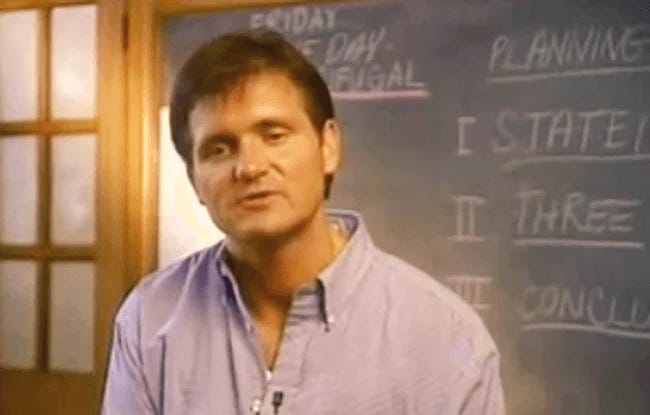
Lesson #1: Don’t discard your ideas
When Kevin Williamson was studying theater at East Carolina University, he wrote a one-act play about a young babysitter who gets a creepy call and starts talking with the other person about all the tropes in horror movies.
According to Williamson, it was a “forty-page mess of ideas” that ultimately never got staged. But the idea never completely left his mind, as you very well know— it became the inspiration for Scream’s iconic opening sequence with Drew Barrymore.
Some ideas need the right time to be told, and to be combined with another idea to create something new. For instance, when James Cameron got the writing assignment for an Alien sequel, he cobbled the pitch proposed by producers Walter Hill and David Giler— marines go to the alien planet and shit happens—with a spec script he’d written eighteen months earlier called ‘Mother’. Voila! That’s how we got Aliens!
For Williamson, the babysitter and the creepy phone call idea just needed another element. And it came to him in the form of a true crime report on the Gainesville Ripper.
Lesson #2: Study the world for ideas
Williamson was house-sitting for a friend in Westwood one night when he stumbled across a prime-time news special about Danny Rolling, the Florida serial killer dubbed the Gainesville Ripper after his horrific murder spree of five college students over four days in Gainesville, Florida, in August 1990.
Williamson recalls:
It was the most gruesome story I had ever heard. It was so horrific the way that he would break into their back doors with a screwdriver. These unsuspecting people, he would just sit outside and listen to them on the phone. Then, when they’d get off the phone, he’d wait for them to go to sleep. It was terrifying.
During a commercial break, Williamson walked into the family room and saw the window open. Had it always been open? Because he certainly hadn’t noticed. Spooked, he tried to call the homeowner and ask if the latter had left the window open when he left.
The homeowner did not answer the call, so Williamson called a friend. He describes the experience:
I was like, ‘Okay, there is a window open in the house. I think someone’s in the house.’ He goes, ‘Well, get out of the house!’ I grabbed a knife and I started walking around, checking under the bed and behind the shower curtain, and he was on the phone with me to keep me company. He was being a jerk and going, ‘Kill kill kill kill.’1 He goes, ‘Yeah, Michael Myers.’ I’m like, ‘No, that’s Jason Voorhees.’ And we got into this whole discussion about horror films.2
Lesson #3: Take from your personal experiences and pay attention to epiphanies
Luckily, there was no intruder in the house. But the experience set off a light bulb in Williamson’s mind.
I thought, ‘I’ll deconstruct the horror film the way that Stephen Sondheim deconstructed [the stories in] Into the Woods.’ That was my favorite musical. I saw it a hundred times when I was waiting tables in New York next door to the Martin Beck Theatre. I kind of used that as my inspiration. I sat down and I was like, ‘Where do I start?’
This is why it’s important for artists to be attuned to their thoughts, something that is becoming increasingly impossible when smartphones and tech companies are desperate to grab and steal every ounce of our attention. For an artist, to be constantly distracted, like most people, is like leaving your front door open every night for a thief to waltz right in and steal your valuables, and not doing anything to stop it.
Anyway.
Armed with his latest experience, plus the creepiness of the Gainesville Ripper, Williamson cast his mind for ideas… and landed on his abandoned idea about the babysitter and the phone call.
“That’s how it all came together,” he says, “and then I started writing the opening scene.”
Lesson #4: Write something that you want to see but is also fresh
Horror films were in a slump in the 1990s. Slashers had done so well in the 1970s that Hollywood churned out a wave of similar films, largely derivative sequels that were increasingly lesser than the film that started it all. According to the New York Film Academy:
If there’s one trope that typifies the ’80s, it’s the slasher format—a relentless antagonist hunting down and killing a bunch of kids in ever-increasing inventive ways, one by one…. Some were a lot better than others as the genre descended to its most kitschy. Similar to the first horror movie, these films were not intended to scare, but to entertain. Suffering from exhaustion in the wake of a thousand formulaic slasher movies and their sequels, the genre lost steam as it moved into the ’90s.
But here’s Williamson, writing for a genre that seemed to be on life support.
Yet early on, he realized that his idea about the babysitter wasn’t enough for an entire movie and changed direction. He says:
I realized: Forget the opening scene. This story is about someone else. I created the character of Sidney Prescott and this whole big story about the death of her mother and how she’s traumatized by that and how it has affected her relationships and who she is and how she navigates high school life.
Lesson #5: Combine genres
How has Scream survived for seven movies over three decades? That’s because it has a story engine that could allow it to run for several stories. In the case of Scream, Williamson combined the slasher genre with the whodunit genre.
He elaborates:
Every horror movie has its thing. For Scream, I thought it could be a mystery where we have a different killer every time and that would be the gimmick (emphasis mine). I was a big Agatha Christie reader as a kid and I really enjoyed the reveals. I read that she works backwards and so I constructed Scream backwards. Once I latched on to two killers, I stopped everything and restructured it so that it all made sense. I already had it all planned out, but when I started taking those two characters and working them backwards, it all fell into place.
I feel really stupid writing this but… until he framed it this way, I had never realized this. When I rewatched the films, it was very apparent that this was a whodunit that was also a teen movie but dressed as a slasher. I can’t believe it took me this long to realize it.
Williamson also did something radical at the time: his characters actually watched horror movies. They knew the tropes and conventions, unlike in other horror films where nobody appeared to have ever seen or much less heard of a horror film before.
Lesson #6: Make it personal, if possible. Also, themes matter!
The first Scream is still the best Scream because it’s actually about something more than just the killings. For this outing, Williamson tapped into the themes of betrayal and family, which felt personal to him. He explains:
I’ve always felt like betrayal is a big thing in my life. I write about it a lot, and lies and deceit. I always felt like Sidney had such a distrust of people around her and she is also dealing with grief. I latched on to her mother being dead and her father being absent as a result of that. Her mother was murdered and she put the guy away, but it was the wrong guy and now she doesn’t trust herself. It’s all about trust. Her whole relationship with herself or with Billy was about that trust and belief in the lies. Can she trust this man she loves? Then she chooses to trust him and he, of course, is the killer.
Focus on themes and character, then weave the scares through them, not the other way around.
Lesson #7: Have a cornerstone on which the movie is built on
While Scream was Williamson’s love letter to slasher films, it was also an indictment of the genre and a pushback against people who blamed entertainment for society’s problems. He succinctly summed it up in a line that ends up in the finished film: “Movies don’t create psychos, movies make psychos more creative.”
He wrote this line on a notecard and taped it to the wall as he wrote; it would become the cornerstone of the story.
Williamson doesn’t believe violent movies cause people to become violent, but it can be suggestive to those already susceptible to violence. He says:
If you look at all the reports, there’s no real relationship. I watched all those violent movies growing up and I’m scared of blood. Real blood, real violence freaks me out. I believe, like Quentin [Tarantino] believes, that the movies are where you can take the darkness. Fiction is the only place you can take this darkness and live in it because you can close the book, and you can turn the TV off, and you can leave the theater. You can play in that darkness and then you step out of it and come back to the real world and you’re in the light.
Later, when the film was in post-production and submitted to the Motion Picture Association of America (MPAA), this line became a battleground. The film’s editor, Patrick Lussier, recalls:
[The MPAA] hated ‘Movies don’t create psychos, movies make psychos more creative’ [because] it was saying a truth that they did not want out there voiced so clearly.
For all its scares and meta-take, Scream has something to say. Genre films get rapped on the knuckles for not having much substance, but the best writers and directors always make sure that what they’re making has something to say.
And since horror is the best vehicle for talking about society and its problems, not having something to say is missing an opportunity to say something meaningful!
Find out what your film is trying to say. Capture it in one line. Let your characters state it. Then make it the cornerstone of your movie.
Once Williamson had all this in mind, he got down to writing the first draft.
Lesson #8: Seclude yourself from the world to write your first draft
Here’s what most people don’t understand about writing: writing is HARD.
It takes honest-to-God effort to sit down and put words on to a page, then continue all the way until the end. That’s why writers are easily distracted. We welcome any excuse NOT to write and then lament over the time lost not writing. It’s fun and not fun simultaneously.
One way that writers overcome this problem is by moving away from their regular environment to write.
It can be a different room in the house, or it can be a small space within the premises like a small office or shed— Roald Dahl wrote all his novels in a shed at the bottom, and Christopher Nolan has a small office unit built separate from his house to do all his writing.
Sometimes, it can be a space in another part of town or the city— Edgar Wright and Simon Pegg got a pokey office in London to write Shaun of the Dead, while Tina Fey wrote Mean Girls in “the backroom of a Fire Island rental home”.
But sometimes, you need a more drastic option: you go away to another place entirely. Rian Johnson frequently secludes himself in an Airbnb to write his scripts once he has all his materials. For Scream, Kevin Williamson did something similar— his friend, the one for whom he’d been house-sitting when he caught the Gainesville Ripper news special, found a condo in Palm Springs that Williamson could have for the weekend.
It was a golden opportunity. Said Williamson:
I thought, ‘I’m gonna go away and I’m gonna write this movie and get it out of my system. I wrote an outline and I took it to Palm Springs. I locked myself in a condo with no TV and for three days I wrote Scream. I came back with a draft. It was pretty close to what I sold.3
Do you have a script you need to write? Once you get all your notes and ideas together, write an outline, then lock yourself away in an unfamiliar place without distractions and get that first draft out of your system as fast as possible.
Lesson #9: Don’t be afraid to mix it up
As mentioned earlier, Scream was not a straightforward slasher film. That’s what Dimension director of production and development Richard Potter thought when he read the script. He actually saw it as a teen movie, recalling:
This was a movie for an audience that was absolutely being ignored at the time. Nobody was making movies for teenagers. I liked how the teenagers spoke. No one can write Kevin Williamson dialogue like Kevin Williamson. They weren’t real, but they were close to real. They had actually seen horror movies. It always killed me, and obviously Kevin also, that when you would watch a horror movie, no one in it seemed to have ever seen one. They had no awareness of the connection between what they’re living through and things they had seen, even just in dialogue.
Funnily enough, the same thing appears to be happening today. Horror films like Obsession, Backrooms, and Iron Lung are aimed at an audience— namely Gen Z— that Hollywood has been ignoring. Which leads to the next point…
Lesson #10: Make a movie for a generation to own
It seems crass to talk about making movies in business terms especially ever since finance shitheads and techbros have encroached the space, calling everything ‘content’, but one thing that absolutely does matter is thinking about your audience.4
Williamson was 30 when he wrote Scream, but his characters were teenagers. And Potter saw immediately that this was a film that teens would be drawn to. He said: “[Teens will] finally have [a movie] for them. Not the fifth one in a franchise that started when they were four. It’s for them.”
AGAIN, THIS IS EXACTLY WHAT IS PLAYING OUT AT THE BOX OFFICE. Including films like The Devil Wears Prada 2 which targeted a female audience, especially older, and is doing MUCH BIGGER business than its predecessor because it is for an audience that is ignored in stories on the big screen from the bigger studios. Gosh, it’s almost like the movie business is cyclical, isn’t it?
Thinking about your audience, simply through the type of characters in your story, can help you to position your script to a specific audience that will turn out to watch. Intentionally or otherwise, Scream positioned itself as a movie for 1990s teenagers without a horror franchise to claim as their own.
Lesson #11: Have champions
Especially for someone struggling to break in, artists need champions and true believers in their work. And Scream had quite a few.
Richard Potter, for instance—he persistently pushed Bob Weinstein at Dimension Films to make the film until the co-founder caved in.
Then producer Cathy Konrad, who produced the first three Scream films, and was an executive producer on the later films. She famously kept the studio at bay in the early days of filming when Dimension got antsy about the dailies and the Ghostface mask. Or, to put it more accurately, she told them if they didn’t like what they were doing, then they should “shut us down or fuck off”.5
Another believer was Julie Plec, who was Wes Craven’s assistant at the time. She loved the script and kept nagging her boss to accept the directing gig— especially since Dimension kept offering it and Craven kept turning it down. One day at lunch, she mentioned that Dimension still hadn’t found a director. “Which is a shame,” she told him, “because that was such a good script and you were always their first choice.”
Craven replied, “Well, they should make me an offer I can’t refuse.”
Plec immediately relayed this to someone she knew. They conveyed it to Dimension Films. And they made him an offer that Wes Craven finally could not refuse.
Lesson #12: Think long-term. Don’t be seduced by the almighty dollar sign
When Kevin Williamson sent the Scream script out in 1995, he was broke and needed money. He didn’t expect the script to start a bidding war in Hollywood. He recalls:
I remember Mandalay tried to buy it. Paramount made an offer and then once it went over the $300,000 mark they were like, ‘We just don’t pay that kind of money for a horror film. That’s not gonna happen.’ Then it got up to four fifty, and then it got up to six hundred or six fifty. Oliver Stone’s company came in higher and Dimension came in lower.
Williamson could have easily sold the script to the highest bidder, so why did he ultimately go with the company making the lowest offer? He credits his lawyer for the decision:
My lawyer Patti Felker, who is my lawyer to this day, smartly said, ‘Do you want the money or do you want the movie made?’ She goes, ‘I really think it’s more important to make the movie.’ I went, ‘Yeah, I want the movie made.’ And she goes, ‘Dimension will make it. Miramax just started this division of genre filmmaking dedicated to this type of film. They will make this movie.’
So Williamson turned his head away from the allure of more money and went instead with the company willing to get it made. True to his lawyer’s word, in less than a year later, Scream hit theaters.
Sometimes, you have to make the smart play to gain for the long-term, even if that means a temporary short-term loss.
Lesson #13: Be audacious and stand out from the crowd
Williamson was inspired by Psycho’s clever tactic of positioning Janet Leigh as the star of the film—only to remove her from the story halfway through. The Casey Becker character in the opening is one such tactic, but when production got underway, it was actress Drew Barrymore who really helped them sell the bait-and-switch: She told Wes Craven that she wanted to play Casey Becker instead of Sidney Prescott, because it would shock audiences if she— a recognizable face— was the teen killed in the opening.
It took a while for Craven to realize the brilliance of Barrymore’s idea. Same with Dimension. But they all saw the genius behind the thinking. In fact, the marketing team would prominently feature Barrymore at the center of the pre-release marketing campaign.
Says Potter:
You’re ahead of the movie thinking, ‘Drew Barrymore is not going to die, she is obviously the star of the movie’. Then she is dead and suddenly anyone could live, anyone could die, you have no idea.
Julie Plec credits this as partly for boosting the film’s popularity at the box office.
I think Drew’s presence in the movie gave it the right credibility, and then the surprise that she died in the opening scene, I don’t think anybody saw coming. People were so gobsmacked by it that it created a level of chatter and awareness that is rare in movies. It’s hard to surprise an audience.
A film has to stand out to get noticed, and today, that’s more urgent than back in 1996. Scream had a strong script and concept that helped, but something like the Drew Barrymore casting only solidified its uniqueness.
Lesson #14: Pay attention to studio notes when they make valid points
Dimension Films only had two notes for the team.
Note #1: The film needed one more kill because the middle had a lull since nobody died.
Given that audiences even back then were liable to check out during the middle stretch, this was a strong point. So they killed off the character of Principal Himbry, played by Henry Winkler. Luckily, his death also created a plausible reason in the story for most people to leave Stu Macher’s house—they wanted to see the body in the football field before police removed it— which set up the place for the final showdown with Ghostface, so it wasn’t a big headache to include it in the story.
The second note was more contentious.
Note #2: The killers needed a motive.
Williamson had purposefully given Billy Loomis and Stu Macher no motives in committing their crime spree. He was inspired by Leopold and Loeb, two notorious teen killers in 1924 who kidnapped and murdered a fourteen-year-old boy. Why? For no reason, except to commit the perfect crime6. Loomis and Macher would be the same because it was more frightening without a motive.
Bob Weinstein wasn’t buying it and got his way.
Still, it wasn’t a major overhaul to address the note. Since the story already had the backstory about Maureen Prescott baked into the story, Williamson added a few lines about her affair with Billy’s father, which led to her death at Billy’s hands and the framing of Cotton Weary. Problem solved. Stu was just along for the ride.
Still, Scream editor Patrick Lussier prefers the original concept. To quote Billy Loomis himself: “It’s a lot scarier when there is no motive.”
Lesson #15: Remember Wes Craven’s advice: “Don’t trust anybody and persevere, really, really persevere. Don’t trust anybody’s judgment about what will work except your own.”
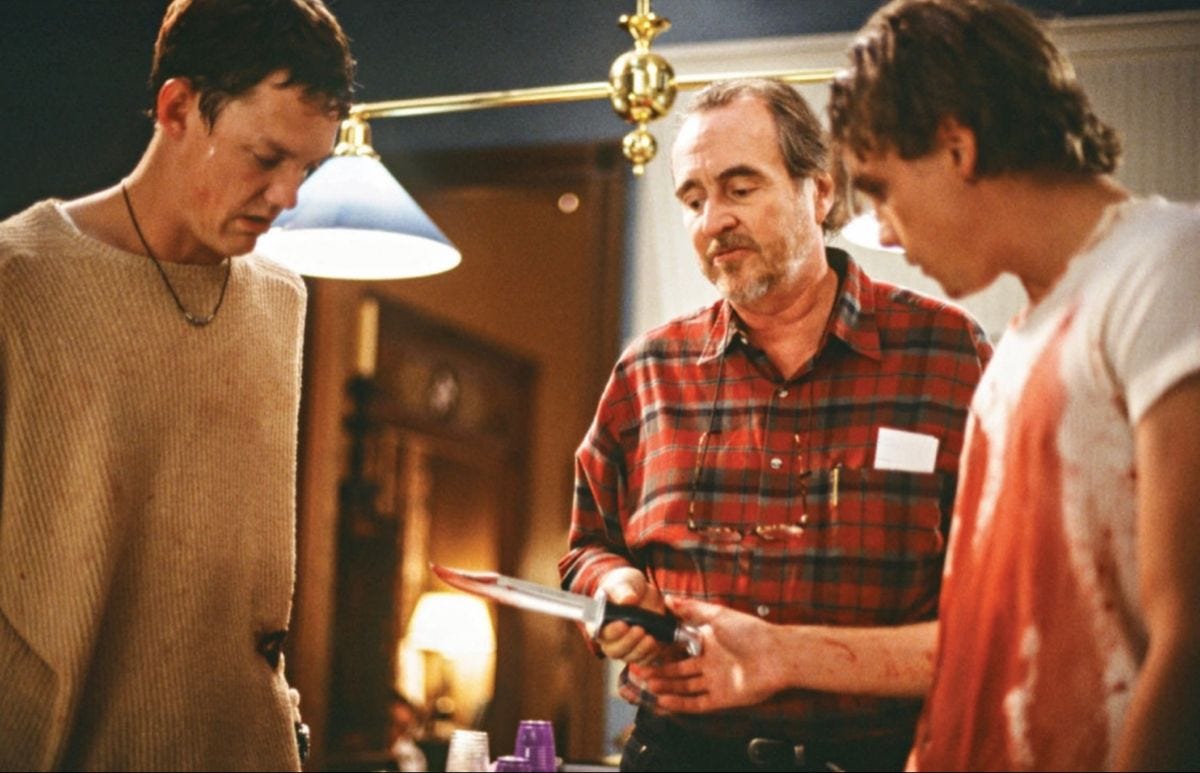
Wes Craven nearly got fired from Scream in the first week of filming.
It had been decided to begin principal photography with the opening scene featuring Drew Barrymore. But though the cast and crew felt they were making something special, Bob Weisten was unimpressed with the dailies. He complained that the footage was “workmanlike at best”, and that it was “just a girl running around with a telephone in her hand.”
Richard Potter, the executive who’d championed Scream, understood why there was a disconnect between the dailies and what his boss, Weinstein, had been expecting. He explains,
When Wes shoots, he is shooting for Patrick [Lussier] to edit. Patrick knows in a forty-second shot that there’s twelve seconds three-quarters of the way through that Wes wanted. That’s what he was going for. When Bob watched the dailies, he thought it looked boring. It didn’t look like anything was happening, and he was kinda freaking out that the movie wasn’t going to be good.
Cathy Konrad, who had made several movies with the Weinsteins, was bracing herself for the worst. She says, “I was the only one that knew to the depth of my soul what could happen when the train comes off the track.” Weinstein sent Dimension Films president, Cary Granat, to Santa Rosa to deal with the situation— and this was the occasion when Konrad famously dared them to shut the production down.
Still, the only way to convince them that they knew what they were doing was to show them what it would look like in the end. So Craven got in touch with Lussier and asked him to stitch the opening scene with music and sound effects. Lussier did, and Potter arranged for Weinstein, Granat, and Andrew Rona to fly to Santa Rosa and watch the now-edited opening scene. After it was finished, Weinstein went up to Craven and said, “What do I know about dailies?”
This changed everything from thereon out. Lussier recalls that Dimension backed “way off” and allowed Craven to make the movie as he saw it. They also were generous with the budget. Lussier says:
“Suddenly, there was money for everything. There was money for an orchestra. All that changed because of that thirteen and a half minutes. My whole career has changed because of that sequence.”
Years later, when asked what advice he’d give young filmmakers, Wes Craven would point to this experience as a cautionary tale. To this, he would add:
If you don’t have that knowledge inside of yourself of what’s going to work for you when you’re making a film, you probably shouldn’t be doing it. But if you have the drive and you have the talent, then don’t let somebody talk you out of it.
I’d say it worked out excellently for Scream and everyone involved in it.
And as for Kevin Williamson, Scream changed everything. He’s never looked back, and I doubt he’s had to house-sit for money ever since.
Do you like scary movies? Which Scream film is your favorite?
The Scream Sequels That Would Never Be

Had things gone according to plan, Scream 7 (currently in theaters) would have been an entire other movie. But it’s not the first time that the franchise took a completely different turn, according to its creator Kevin Williamson. When Williamson and director Wes Craven reunited to make
Thanks for reading! If you liked this essay, you can sign up here for more issues. If you’d like to support Three Left Feet Media, share this newsletter with a fellow film lover you think would appreciate it.
Long live the movies!
D.L. Holmes
This moment gets recreated in Scream 2 when Cici Cooper (Sarah Michelle Gellar) is alone in her sorority house and hears a noise upstairs. She’s on the phone with a friend and the friend goes, ‘Kill kill kill kill’.
Although the friend is being a dick, I also love how in the middle of a potentially scary situation, these two are talking about horror films.
I should mention that right until post-production, the film was called Scary Movie. It was Harvey Weinstein who proposed calling it ‘Wes Craven’s Scream’, inspired by the Michael Jackson-Janet Jackson single ‘Scream’. Everyone hated it… until the film did gangbusters at the box office. In 2000, the Wayans used the title for their horror parody.
Or as the smug MBA holders would say: “product-market fit”. Urgh.
Wisely, they fucked off in the end.
Since they got caught, it really wasn’t perfect after all. The Leopold and Loeb crime became popular in pop culture, serving as the influence for Alfred Hitchcock’s Rope.