

Harry Potter And The Half-Blood Prince: Good-Looking But Incomprehensible
The sixth Potter film trades mystery for comedy and eliminates crucial lore for teenage romance, making it the weakest and most baffling adaptation in the series.

When it comes to determining what makes a successful book-to-film adaptation, I have a simple rule of thumb: Do I understand what is happening in the film without having read the book?
Do I need to read J.R.R. Tolkien’s books to know what’s happening in Peter Jackson’s Lord of the Rings trilogy?
Do I need to read Frank Herbert’s Dune (and Dune: Messiah) to enjoy Denis Villeneuve’s three-film series?
Do I need to read Peter Benchley’s Jaws to understand Steven Spielberg’s blockbuster film?
In the cases of the above three examples, the answer is no. In fact, I read Tolkien’s trilogy after watching the films— Peter Jackson’s adaptation was my gateway to the books. I’ve never read Dune but I can follow what’s happening in Denis Villeneuve’s movies. As for Jaws, I get the impression I’m better off not reading the book1.
Up until now, one could enjoy the Harry Potter films on its own terms without ever picking up the book. Some bits can get a little confusing if you haven’t read them— like how did Lupin and Sirius know about the Map in Prisoner of Azkaban?— but it wasn’t enough to leave you flummoxed. I’ll even argue that Order of the Phoenix, despite being cut to the bone and a bit more in the adaptation, still manages to work on its own.
The same can’t be said for Harry Potter and the Half-Blood Prince. For the first time, a casual viewer might be a little lost with what’s going on, and that’s because the adaptation downplays the franchise’s core components and focuses on trivial stuff instead.
It fails my simple metric, and thus, that makes Half-Blood Prince the weakest film in the bunch.2
For a film I claim as the “weakest”, Harry Potter and the Half-Blood Prince did quite well. It got better ratings than the previous entry, Order of the Phoenix, though it made less than that film and had the biggest budget compared to the other entries at that point.
And it’s handsomely made, even I can’t deny that. If each Harry Potter film is a child in a family, then this one is the best-looking sibling. Which is saying a lot because “gorgeous” is an adjective you’d rarely use to describe large-scale blockbuster movies.
So what makes it a bad adaptation?
Harry Potter And The Order Of The Phoenix: A Creative Turn For Better Or Worse?

Two things can be true simultaneously: Harry Potter and the Order of the Phoenix was the second-best performing film in the series in 2007 and got the lowest collective review scores at the time.
When I wrote about Chamber of Secrets, I declared that the Harry Potter stories were basically mystery novels with wizards, and Harry Potter as a child detective. Where Hercule Poirot had a magnificent mustache and his “grey cells”, and Sherlock Holmes had his magnifying glass and deerstalker cap, Harry had a magic wand and a scar on his forehead. And like any good series, there was a formula.
Harry is stuck with the Dursleys for the summer holidays and miserable
Harry cuts short his stay with the Dursleys and goes away, usually with the Weasleys— Hermione often joins
Harry returns to Hogwarts
New Defence Against the Dark Arts teacher— sus or not?
School stuff
New mystery afoot
Christmas and Easter holidays
Final exams
Mystery reaches crisis around the time of final exams
Harry uncovers the truth behind mystery, and it’s connected to his past and arch-nemesis Voldemort
Harry saves the day
Gryffindor wins the House Cup
Harry goes back home to the Dursleys for the summer holidays (in the case of the films, it ends in Hogwarts but still at the end of the school year)
Now formulas in a franchise get a bad rep but that’s when the story is running on autopilot. Good writers and filmmakers find a way to make the formula work. The James Bond films are the best example: classics like Goldfinger and Casino Royale are structurally identical to the weaker films such as Live and Let Die and Quantum of Solace. There’s the pre-title sequence, Bond is given the assignment, Bond gets either a car or gadgets or both, Bond seduces the girl, Bond beats the bad guy. Sometimes, the film will deviate slightly from the formula— Bond loses the girl in Casino Royale, Bond goes rogue in Licence to Kill— but for the most part, that’s how it goes.
The problem isn’t the formula; it’s mistaking the superfluous stuff for being more interesting. In the Bond films, the ones that pay more attention to the gadgets or large-scale set pieces versus the mission are the films considered the weakest.
And that’s what Harry Potter and the Half-Blood Prince does: it forgets about the mystery, and instead ramps up the romance and comedy to turn it into an expensive BBC sitcom.
Which is a bit odd because the book has about SIX mysteries running at the same time:
Who is the Half-Blood Prince?
What is the memory that Professor Slughorn is ashamed to reveal?
Why did Professor Dumbledore make Snape the Defence Against the Dark Arts teacher?
What is Draco Malfoy up to?
What is the story behind Voldemort’s past?
What are the Horcruxes?
Now— to be fair: the film doesn’t ignore these mysteries wholesale. Well, except #3— that gets one nod at the feast, and then it’s completely forgotten, making this the second film not to feature a Defence Against the Dark Arts lesson3. Out of the six, the ones that get the biggest focus are #2 (Slughorn’s memory) and #4 (Malfoy). But numbers #5 and #6 gets truncated— Voldemort’s past is restricted to just memories of him as a boy; and the Horcruxes are glossed quite quickly. So much so that the relevance of the objects— trinkets connected to Hogwarts or Voldemort— are lost unless you’ve read the books.
As for the mystery of the Half-Blood Prince… well, you’d be forgiven for being baffled by Alan Rickman’s reveal towards the end. No explanation is given as to WHY he’s called that; the film barely even tries to drum up interest in the character’s identity. Even though… you know, the film’s subtitle is literally about the HALF-BLOOD PRINCE.
So who’s to fault here?
David Yates was asked if he’d like to direct Half-Blood Prince while still working on Order of the Phoenix. It was a sign that producers David Heyman and David Barron—as well as Warner Bros. studio—were happy with his work. This also made it the first time since Chris Columbus was hired that they didn’t have to look for another director4. In fact, halfway through production on Half-Blood Prince, the producers asked if Yates would like to finish the franchise, making Yates the only director to make more than two Potter movies.
After sitting out the fifth film, Steve Kloves also returned for scribe duties on Half-Blood Prince. And both of them had ideas about deviating from the Potter formula.
For instance, it was Kloves who proposed breaking the pattern of starting every Harry Potter story with the Dursleys. Yates explains:
Steve [Kloves] came up with this notion that, after Order of the Phoenix, Harry’s in this quite intense, dark place and he’s riding the trains to free his brain a wee bit. He meets this really attractive waitress who he really likes. You immediately set up the notion that suddenly these characters are a bit more sexualized, if you like. They’re aware of the opposite sex and their hormones are kicking off. I thought it was a really charming, lovely idea.
It is effective, though it’s a bit of a pity because in Book Six, the scene with the Dursleys does provide some context about why Dumbledore sent Harry to live with them. Still, I think the changed opening is good. It works. A good adaptation doesn’t slavishly recreate the source material; it takes the spirit of what worked to create something new.
But prior to that, Yates had an idea: What if they opened with an action piece showing the Death Eaters attacking London, something hinted at in the book? The collapsing bridge is mentioned as a throwaway line, but to David Heyman, he felt such a dramatic opening would capture the heart of the story’s increasing darkness:
We really like the idea that these magical places are so close to us—that the wizarding world exists right next door to our world, around every corner. Witnessing a Death Eater attack on places both magical and familiar reinforces that fantastic possibility.
Additionally, the Deathly Hallows was published by this time, so some of the events in Film Six would be influenced by the final book— hence, the seemingly throwaway setup where the Death Eaters kidnap Ollivander the wandmaker to explore in the next film. Again, it works— although the action scenes are mostly spectacle without any reversals or changes to make it dramatic.
Just as the beginning would be modified, so too would the ending. As much as the three Davids and Kloves desired to depict Dumbledore’s funeral, they realized that a funeral would disrupt the rhythm of the film and pacing after already showing his death,. Early drafts did contain the funeral scene but Heyman found it underwhelming and had it taken out. The battle between the Death Eaters and the Order of the Phoenix (plus Neville Longbottom and Luna Lovegood) was also removed to avoid repeating it with the Battle of Hogwarts in the final film.
The idea to play up the romance and comedy seems to have been a collective responsibility. In an interview, Yates said:
We all got on really well and the studio and the Davids really liked the work even before 5 came out, they said that I’d do 6. We had a conversation that went like this. They said, “We think we’d like you to do 6, but can you do comedy?” I was like one of those actors trying to get a job. “Can you ride a horse? Can you do a French accent?” I said, “Of course I can do comedy!”
Not that the comedy and romance is unimportant— but imagine if a Bond film put more focus on the romance while downplaying the mission at hand, and you’ll get the Half-Blood Prince.
Voldemort’s past became a point of contention between writer and director. Kloves wanted to show it, but Yates felt it was more important to concentrate on Voldemort as a young boy and his relationship with Slughorn. The disagreement must have been quite strong because in the end, Yates had to actually veto the writer.
We thought it was more important, in the limited screen time we had, to concentrate on Voldemort as a young boy in the orphanage and Voldemort's relationship with Slughorn.
Which is funny, because to compensate for this absence, it was Yates who gave us a scene in which Ron sits between Harry and Ginny and offers a mince pie:
That was just a bit of improvisation. There was just a big plate of pies and I went, “Rupert, I know what we’ll do, let’s try this” and then Steve [Kloves] writes a lot of really funny stuff which I adore, and the guys adore doing. I think we need to keep that. I think audiences enjoy it, it keeps them in the right mood.
No, my guy. Just… no. It’s fun but not at the expense of what the film is about.
And then there was the attack on The Burrow halfway through that was added. Yates explained why:
First of all, it felt like the middle of the story needed an injection of jeopardy and danger. That doesn’t exist in the book, but when we were developing the script, it felt like there was a lot of comedy and a lot of lightness and as a rhythm, it kind of felt like it continued for too long. Putting some jeopardy right in the middle just felt, it would just remind the audience that the world beyond Hogwarts is still a very dangerous place.
A good sentiment— for instance, the death of Henry Winkler’s principal in Scream was added because Dimension felt there was a lull in the middle of the film without any kills. But that addition, for instance, actually sets up the scene later when the house is emptied for the final act. The attack on The Burrow… doesn’t actually further the story.
Do you know how you can tell if a scene doesn’t add to the overall story? Remove it and see if it affects the rest of the narrative. If yes, then it’s necessary. If no, then it is expendable. If you take out the attack on the Burrow, the film… continues as normal.
Look, the Half-Blood Prince book is the most episodic one of the lot, which meant that not everything was not going to make it to the screen. That’s the reality. But I’m not alone in the fact that the film is a little incomprehensible. Apart from casual viewers people complaining about not understanding what is going on, even the critics pointed this out:
Roger Ebert wrote, “The middle passages spin their wheels somewhat, hurrying about to establish events and places not absolutely essential. But those scenes may be especially valued by devoted students of the Potter saga. They may also be the only ones who fully understand them; ordinary viewers may be excused for feeling baffled some of the time.”
David Stratton of Margaret and David at the Movies wrote, “For non-readers, the films are now borderline incomprehensible, because so much prior knowledge is assumed, but I understand from loyal book readers that, especially in this new film, a great deal of important incident has been deleted.”
Dave Golder of SFX Magazine thought the film spent “huge swathes of the film to subplots about Harry and his chums’ teenage romances, while treating the plot with apparent disinterest – an unfortunate necessity to be dealt with in as few lines as possible” and that “exposition is cut to such a bare minimum that those unfamiliar with the story may be mystified about what’s going on”.
If someone who hasn’t read the books needs to ask what is going on, that is the mark of a bad adaptation.
That being said, let’s talk about the cinematography. There’s quite a bit to learn here.
As I mentioned earlier, the Half-Blood Prince film is the best-looking one of the bunch. Bruno Delbonnel (Amélie) wanted to light the set differently from past cinematographers, explaining:
Some of the sets are there since the very first Potter. How could I light them in a different way? This question brought another one based on the series itself. It was Potter number six, the story was less about the big fights than the relationships between the characters. Nevertheless the drama is still there and I thought it would be interesting to have those very intimate stories amidst this very dark mood. As if the school was a dark character. That’s when I suggested to go for this (again) dark moody variations of grays.
Even the light-hearted scenes are painted with bleak colors and a dreamlike glow. More wide shots appear, as well as silhouetting the subjects. Plus, Delbonnel framed scenes in a way that wasn’t simply straight-up pointing the camera at what was happening in front of them.


The scene in the cave was a particular challenge. In the book, the only source of light came from a bowl in the middle of the cave, making it static. So Delbonnel decided to add a light rising in to the air and circling around Harry and Dumbledore, creating an unsettling atmosphere to an already creepy scene.
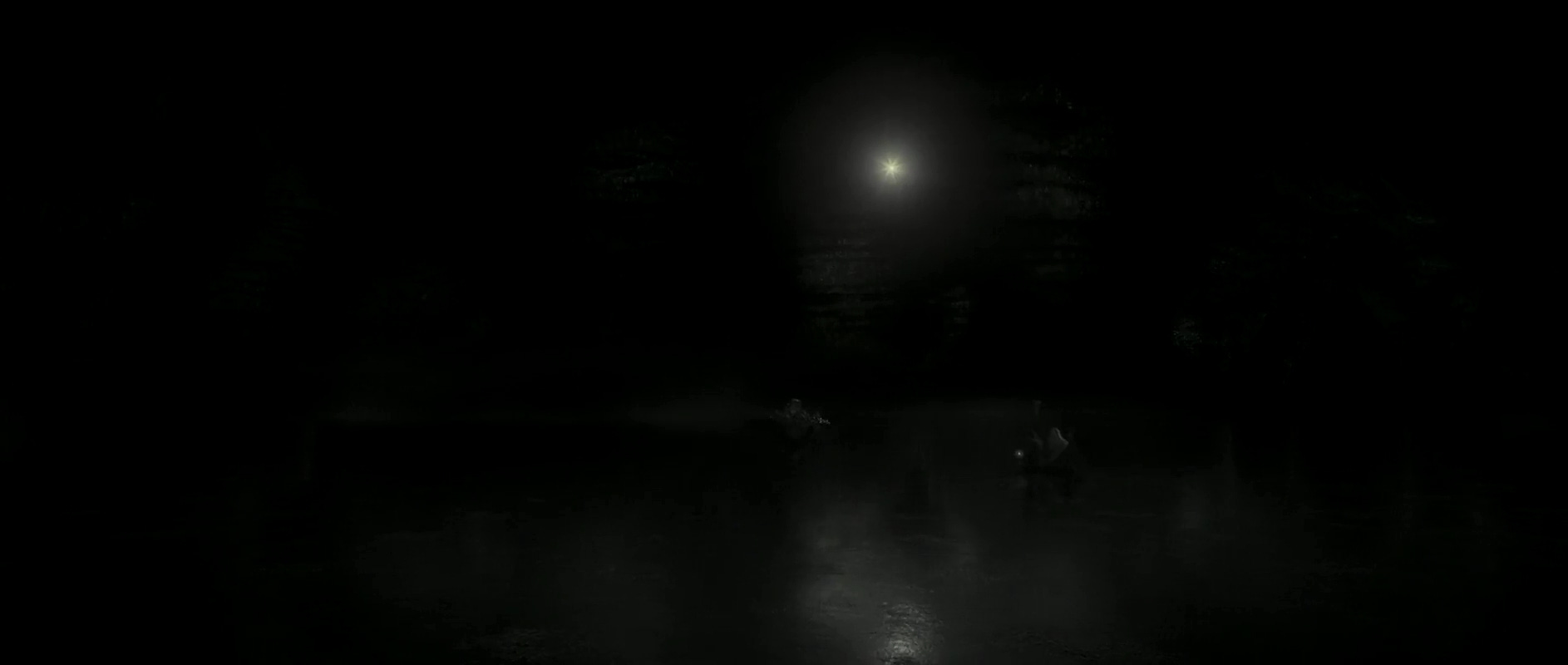
Yates explained that he and Delbonnel arrived at the film’s look through digital grading, something that the cinematographer worked on daily, creating a half-dozen ‘looks’ for the studio. But Warner Bros. didn’t like one of the looks, citing their dislike of the “very European looking film”. Yates recounts:
So we sat with the execs and got to the bottom of what they didn’t like. We had a very European looking film – which we wanted to retain, so we didn’t want to compromise on that. Bruno [Delbonnel] had also used some de-focussing and soft wipes in the digital grade that unsettled them.
So Delbonnel went back with colourist Peter Doyle and started adding back a little color while taking out the soft wipes and defocusing. Yates rememebers:
It looked really beautiful – all the soft wipes and de-focussing had gone, and you could see all of Stuart [Craig’s] sets, the costumes. It was a real journey for us. So we phoned up the studio and said, “Come and have a look at it now – we’ve made changes. It’s not what you wanted, but we’re happy with it”. So they flew over, watched the first five minutes of it, and said, “This is beautiful – we’re so happy!”
As for Delbonnel, he called it his best work at the time!5 The Academy certainly thought so, nominating him for the Best Cinematography Oscar.
A successful adaptation needs to stand on its own two feet without requiring a little homework to be understood. There’s still a sense of ambition and swinging for the fences six films in— on a production level, Harry Potter and the Half-Blood Prince is the franchise’s biggest swing yet and I admire that. But while creative change is necessary and healthy for a franchise’s longevity, it should never come at the expense of forgetting its core appeal and engine. The wrong type of change in creative direction can do damage, and it’s sheer luck that enough people turned out for the film as it was time to land the plane, after nearly a decade, and end the Harry Potter series. Not with one film, but two…
Thanks for reading! If you liked this essay, you can sign up here for more issues. If you’d like to support Three Left Feet Media, share this newsletter with a fellow film lover you think would appreciate it.
Long live the movies!
D.L. Holmes
Sub-plots in the book apparently include the Mafia, Ellen Brody having an affair with Hooper, and a very different ending. Seems like the shark was the more interesting character.
Up until this point, anyway.
Philosopher’s Stone didn’t have, either BUT there was a short glimpse of Quirrel at work when Professor McGonagall summons Quidditch Captain Wood from the class.
Guillermo del Toro reportedly turned down an offer to direct Hellboy II: The Golden Army instead; Alfonso Cuarón had expressed interest in making another Potter film (though he and David Heyman would reunite on Gravity, which earned Heyman his first Oscar nomination for Best Picture (later nominations were for Marriage Story, Once Upon A Time In Hollywood, and Barbie).
Which is saying a lot, since his post-Potter credits include: Inside Llewyn Davis for the Coen Brothers, The Tragedy of Macbeth for Joel Coen, and Darkest Hour for Joe Wright— earning Oscar nominations for each one! He was also the co-cinematographer for the TV series Disclosure for Potter alum Cuarón.
Excellent write up on this film. I remember I re-visited Half Blood Prince last year, and immediately what jumped out was how much focus there was on the romance components. There's nothing inherently wrong with that, but I found it to be poorly constructed and executed. The chemistry was off between the actors, there wasn't much scene wise to build the chemistry, and all of it felt ham fistedly hollow. I think I described it as "a drama on the CW, but without the intrigue". That component definitely took me out of this Harry Potter film