

Lessons From 'The Dark Knight': The Art Of Making A Personal Blockbuster
For the sequel, Christopher Nolan made a radical departure from the world of Batman Begins, creating the superhero comic book version of a crime urban drama.

It’s almost a cliché to admit that I love The Dark Knight but I do. Watching it, I remember thinking that this is the type of movie I want to make: commercial and artistic; entertaining while also providing food for thought. In a superhero movie, of all places!
With The Dark Knight, it became very clear that Christopher Nolan was a director who thrived in making films that had cerebral underpinnings while also aiming for maximalist thrills. The man was born to film trucks being flipped for real in the middle of a Chicago street! But if you read/watch his interviews, he is also someone who thinks a lot about the world, about cinema, about literature— and not in the pretentious shallow way, either. If he hadn’t gone into filmmaking, he could easily have become a erudite professor, the kind you’d want to hang out with and talk about things over a cup of tea. Maybe two, even!
And The Dark Knight was the film that really allowed Nolan to marry his artistic sensibilities to a big-budget tentpole film— based on an existing IP, no less. It shouldn’t have worked; there are parts that he himself admits that he didn’t think would turn out well, only it did. The result is a film that is very much his, in a way that few superhero films or blockbusters can boast.
So how did he do it, and what does that have to teach us in our own approach to making films?
Lesson #1: Start Your Film By Thinking Of An Image
“You either die a hero or live long enough to see yourself become the villain. I’m whatever Gotham needs me to be. A hero, not the hero we deserve—the hero we need… Because sometimes the truth isn’t good enough. Sometimes people deserve more.” – Batman, The Dark Knight
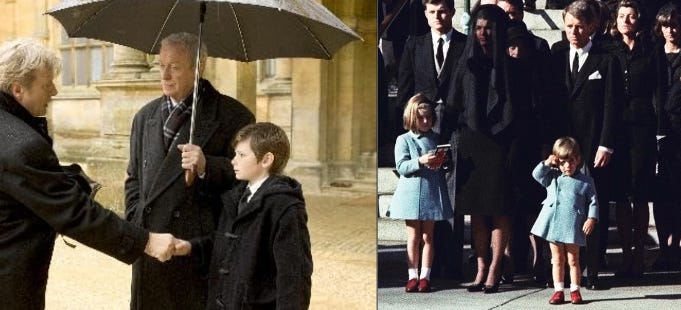
When working on Batman Begins, Christopher Nolan and David S. Goyer started with the image of Bruce Wayne as a small boy at his parents’ funeral. Inspired by the real photo of a three-year-old John F. Kennedy Jr. at his father’s funeral, it captured what kind of Batman story that Nolan wanted to tell: one that focused on the man under the mask and how he got to being Batman. Thinking about the image allowed them to also think about what the teaser trailer would show, and what the marketing department could use to promote Batman Begins as an origin story.
Once again, when thinking about what he wanted to see in a Batman sequel, Nolan was struck by an image that came to him while scouting locations in Hong Kong: Batman on foot, being chased across the rooftops by the police. Even though it would be reworked, this image served as the bedrock for the film’s trajectory, in which the hero takes the fall for a villain to save the city, and disappears into the night, disgraced and disavowed.
Jonathan Nolan, the film’s co-writer and the director’s younger brother, elaborated:
Chris [Nolan] is very driven by endings, and he likes to pare down endings to an image. In early drafts of the script, that image was of Batman on foot, being chased from rooftop to rooftop. In the final version of the script, we had him on his amazing Bat-Pod, but it was the same essential image—Batman being pursued by the people he’s just helped to save. There was something very tragic about that.
Already famous for his endings, Nolan’s choice to end The Dark Knight on such a note evokes his love of noir, which influenced his early films— especially Raymond Chandler. His private detective Philip Marlowe mirrors Nolan’s Batman, a man navigating a corrupt rotten world and trying to do his best, though the truth may never come out. There’s something valuable in approaching a film script by starting with an image that encapsulates what it is about. After all, film is a visual medium.
Lesson #2: Steal Like An Artist And Draw From Many Influences
Nolan has admitted that he is not well-versed in comic books. That’s why he brought comic book super-fan Goyer to help him make his Batman movies. He’s not trying to make a comic book movie, he’s trying to make a good movie based on comics, starting with the source material while fleshing it out with other influences. He elaborates:
I’m not attempting to represent the medium of comic books on screen here anymore than I would a novel that I was adapting or a stage play. It’s a different medium and when I read a comic book I’m able to interpolate a real world from the drawings.
Two Batman comics were a huge influence on The Dark Knight:
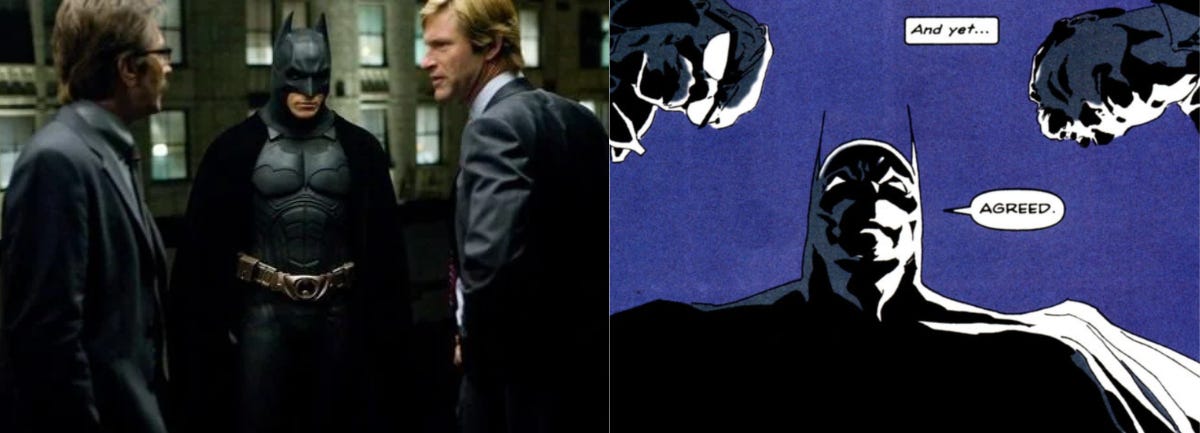
Jeph Loeb’s and Tim Sale’s limited series Batman: The Long Halloween, which also influenced Batman Begins in its depiction of Batman’s war against the criminal faction represented by Carmine Falcone. For The Dark Knight, the Nolans and Goyer took the alliance between Batman, Commissioner Gordon, and Harvey Dent and made it central to the film— the scene of the three men on the rooftop is lifted from the comic book’s panels.
Alan Moore’s The Killing Joke, in its depiction of the Joker. Nolan explains:
… I definitely feel the influence of The Killing Joke, not so much in the specifics as in constructing some sense of purpose for an inherently purposeless character. That is to say The Joker is an anarchist. He’s dedicated to chaos. He should really have no purpose but I think the underlying belief that Alan Moore got across very clearly is that on some level The Joker wants to pull everybody down to his level and show that he’s not an unusual monster and that everyone else can be debased and corrupted like he is.1
You might also be surprised to know that Heath Ledger’s Joker mirrors the character’s very first appearance in the 1940’s Batman comics in issues #1 and #2 with the Joker described as a kind of “grim jester”. Nolan recalls:
It’s a weird thing. [Jonathan Nolan] called me up halfway through his job and said, “By the way, have you looked at [Joker’s] first and second appearance recently?” And I think maybe years ago I’d seen them. I think David Goyer had told me about them. Went back and looked at them and we wound up at a place that’s drawn very directly from that stuff.
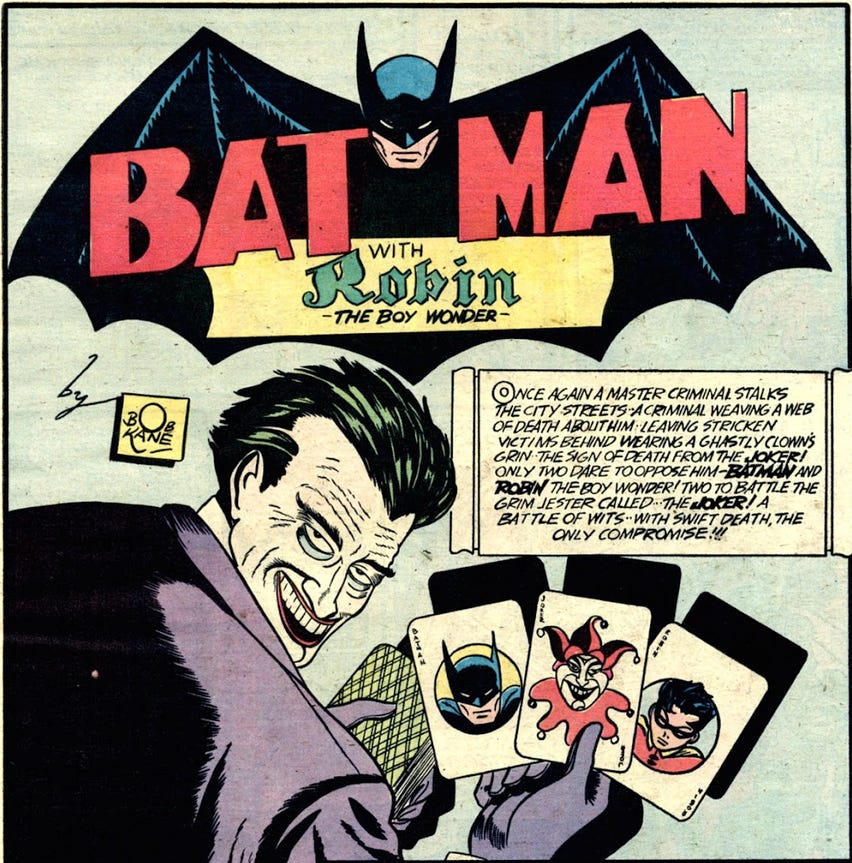
However, he emphasizes that it was a coincidence:
… we arrived at it in our own way by researching a lot of the more recent Joker stuff, and thinking about what this icon is when viewed through the prism of Batman Begins. When viewed in the world we created, in the tone we created. And what we arrived at is somebody who is quite a serious guy, really, considering his name’s the Joker and that turned out to be quite similar to his original conception.
To build up on the realistic take he brought to the superhero, Nolan turned to movies to help him conceptualize the sequel. One big influence was Michael Mann’s crime crime drama Heat (1995) in finding a way to use Gotham City as its own character (Nolan loves the film so much that he moderated a Q&A with Mann, Al Pacino, and Robert De Niro for its 20th anniversary). If Batman Begins was more like James Bond in its globe-trotting approach, The Dark Knight would remain constricted to Gotham City (with only a brief sojourn to Hong Kong). Nolan explains:
Batman Begins had been as big as we could make it. I knew we couldn’t stuff any more in, geographically. So you have to look at the scale in a different way. What I wound up doing is looking at it differently in terms of storytelling and cinematography. One of the biggest epic films I have ever seen is Michael Mann’s Heat. That is a true Los Angeles story, just wall-to-wall within the city. Okay, we’ll make it a city story. We’re going to shoot in a real city, with real streets and real buildings, because the scale of that can be massive.”
He continues:
Heat was very much an influence, because Mann is a fanatic for architecture, too; he understands the grandeur of a city and how it can become a kind of epic playground. I don’t think we realized what an icon that image of the Joker on that street would be. That’s the thing about iconography: You try and build it consciously in all films, and sometimes it’s something you know, but sometimes you don’t. We put a lot of thinking in it, it wasn’t unplanned, but it wasn’t until we saw the IMAX footage that we really knew it.
Another influence was the TV series The Wire— Jonathan Nolan was a big fan of how creator David Simon told his crime drama in a key of realism while it ultimately develops into a Greek tragedy. So too was The Godfather in focusing on the world of crime.
Sidney Lumet’s Serpico was a big influence on Batman Begins, about one man trying to fight corruption in the city. A lesser-known Lumet film, The Offence (1973) influenced The Dark Knight, particularly in a scene where Sean Connery’s ferocious Manchester police detective batters away impotently at a laughing child molester (Ian Bannen)— similar to how Batman uselessly hammers a maniacally laughing Joker in the police interrogation room, unaffected by the Caped Crusader. In The Offence, Connery’s detective goes to criminal lengths to get his solution; in The Dark Knight, Batman too would employ troubling tactics to fight back against Gotham’s criminal underworld. This also ties into the themes of escalation hinted at by Gordon at the end of Batman Begins; here, we see how it plays out; the only two people to question Batman are Gordan and the Q-like Lucius Fox (Morgan Freeman). The one person who doesn’t question Batman? Harvey Dent.
Nolan says:
Harvey doesn’t question Batman as much as Gordon does, and therein lie the seeds of his ultimate trouble, because what Batman does is questionable. There are some disturbing ramifications to the way Batman chooses to fight crime, but Harvey Dent is in favor of Batman’s approach, and avails himself of the advantage it gives him in fighting criminals— which immediately raises the question: How far will Harvey Dent go?
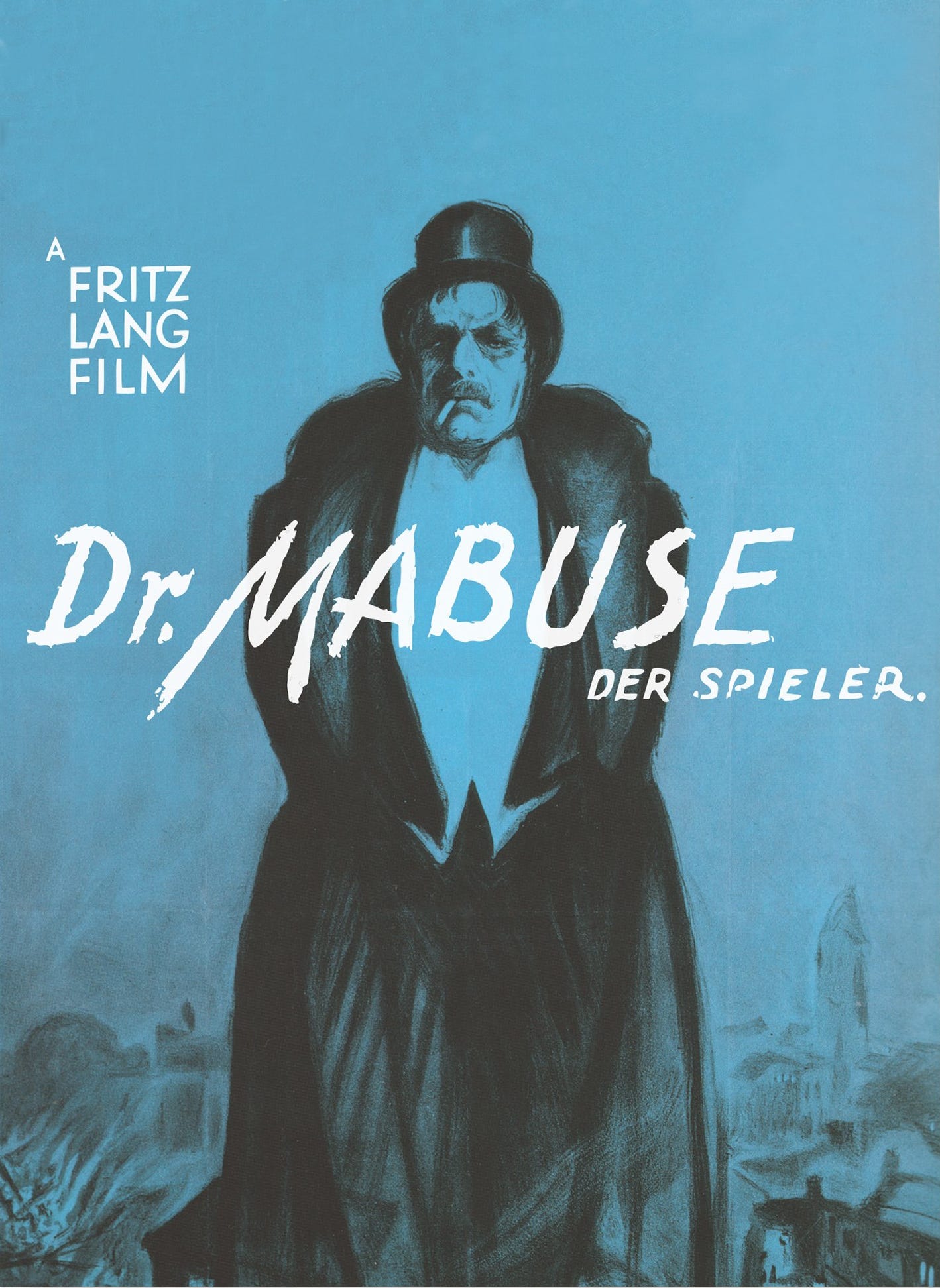
Nolan doesn’t stop there. One major influence on The Dark Knight was Fritz Lang’s silent film Dr. Mabuse The Gambler (1922), particularly in conceiving the character of the Joker. Nolan explains:
[Mabuse] was the direct feed because that gave us the original master criminal. I had Jonah [Nolan] watch Dr. Mabuse and said to him, ‘This is what we’re going to make the Joker and he’s going to be the engine of the story.’ He totally got it. My brother’s early drafts had a lot of impracticalities and a lot of amazing ideas, but the thing that he absolutely nailed was the character of the Joker. He just had that down. When Jonah came back with his draft, it was like, ‘Yeah, there’s still work to do,’ but the Joker was absolutely there and his effect on the story.
In approaching the Joker, another film that provided a template was Jaws. Or more accurately, the shark in Jaws. Goyer recounts how he and Nolan wanted the villain to arrive in the film fully formed, saying:
We always talked about the Joker as being like the shark in Jaws, this force of nature that is unknowable. That’s why he has a kind of ‘choose your own’ origin story. We never wanted to explain his origin, which had become another lame convention of these types of movies. With each successive film, it was ‘What’s the origin of the new villain?’ That had become a real cliché, and so we decided to subvert that by not showing his origin at all, which we thought would make him much scarier. The Joker had never been scary in previous film depictions, but we were determined to make him very scary in The Dark Knight.
A big influence on the late Heath Ledger’s portrayal came from Stanley Kubrick’s A Clockwork Orange2, namely the character of Alex (Malcolm McDowell). Years after he finished the Dark Knight trilogy, Nolan recalls:
I think Alex was the closest to the Joker that had come before. He’s a teenager essentially. He’s just ‘I’m just going to tear it down because fuck it.’ He doesn’t even care about why he’s doing it. He’s that out there. It’s a very real force of human nature, and it’s not one that I have. I’m afraid of that in myself. I’m afraid of that side of human nature. The Joker is what I’m afraid of more than anything, more than any of the villains, these days particularly, when you feel civilization is very thinly lined. I think the Joker represents the id in all of this. All three films, we did with a real truthfulness of our intentions. What do we worry about? What am I actually afraid of? What’s the worst thing the villain could be doing? I don’t have that anarchic impulse, I really don’t. I’m much more controlled. I’m afraid of that in myself. I feel like I carefully used it as the engine of the movie, but I was afraid of it the whole time I was making the film.
Nolan didn’t stop there when it came to references. For creating the look of the Joker, he directed costume designer Lindy Hemming and her team to the works of Francis Bacon, especially his painting Study After Velàzquez’s Portrait of Pope Innocent X (1953) (more familiarly known as ‘The Screaming Pope’) which conveyed the Joker’s “edgy, unsettling essence” to the filmmaker. For Hemming, it convinced her that a purple suit would work on the actor.
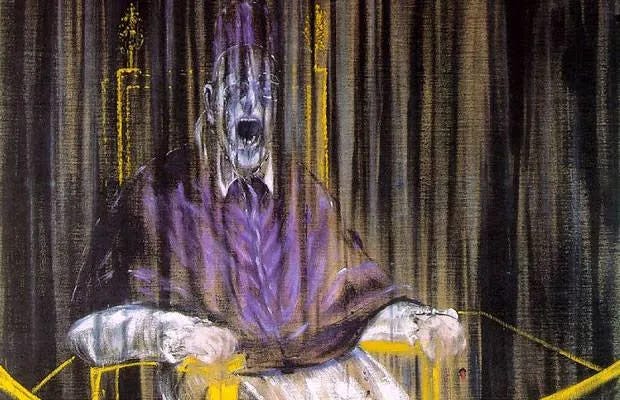
For her part, Hemming collected images from Vivienne Westwood—the British fashion designer famous for bright colors, radical lines, and geometric prints— and pictures of Iggy Pop, Johnny Rotten, and Pete Doherty to help in creating the look of the Joker for Nolan’s realistic world.
I’ve made this point before in previous posts, but this is why it’s important to watch and read widely. The ability to draw from a big pool of references and influences can enrich a film to create something original. Quentin Tarantino does this on all of his films, lifting from obscure titles and remixing it through his own particular style to create something different; Nolan does the same. I mean, how many people have heard of— much less watched— Dr. Mabuse the Gambler3? I’ve seen the sequel, The Testament of Dr. Mabuse, and I could see what Nolan must have been going for.
Lesson #3: Collaborate With Talented Writers Who Push You
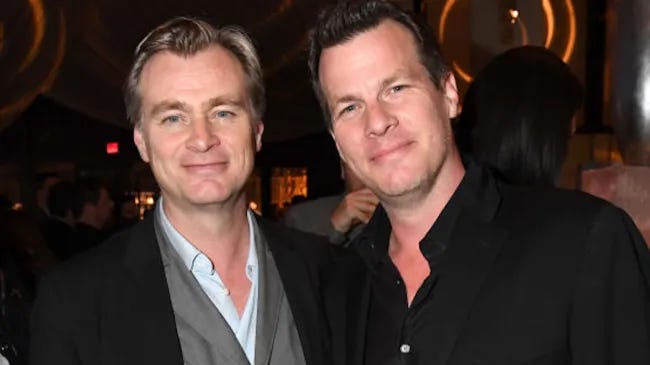
Christopher Nolan gets a lot of credit for the Dark Knight trilogy, but his collaborators on the page— David S. Goyer and Jonathan Nolan— deserve equal credit for their contributions to the script.
The process of writing the script turned out to be quite similar to Batman Begins. First, Nolan and Goyer worked out the story over 2-3 months, writing down the main beats on index cards. This time, however, Goyer did not write the first draft; that task fell instead to Jonathan Nolan4. According to older brother Christopher Nolan:
We sent Jonah [Nolan] off to work on his own because I was working on [The Prestige] so he had 6 months to do that first draft and he would show me stuff as he did it and I would look at it before he shared it with anyone else including Chuck [Roven] and the studio. After the studio read the first draft Jonah spent another couple months working on it and then I took it over when I finished the other film and over the course of 6 months in pre-production, Jonah and I still worked heavily on it through that time.
One of the reasons it took one-and-a-half years to get the script right was because the story they had in mind was quite sprawling as they tried to fit all the ideas they had, testing different versions and taking out different story elements. He admits:
One of the reasons the film is 2-and-a-half hours long is because we tried everything we could on paper to make the story shorter but that was the story we had. In the end we compressed it to the point where it was dizzying so then we had to flesh it out a little bit.
Jonathan Nolan’s work cannot be overstated, being responsible for two big moments in The Dark Knight. The first is distilling the story’s essence and themes into one of the film’s most popular lines: You either die a hero or you live long enough to see yourself become the villain. Jonathan explains:
The idea that you either die a hero or you live long enough to see yourself become the villain is really the theme of the movie for me. And Batman lives long enough to see himself become the villain, or to allow himself to be mistaken for the villain. That was the idea coming out of the story that David [Goyer] and Chris had put together that most excited me.
Years later, Christopher Nolan would reveal in an interview that he initially didn’t get the line:
I’m plagued by a line from The Dark Knight, and I’m plagued by it because I didn’t write it. My brother wrote it. It kills me, because it’s the line that most resonates. And at the time, I didn’t even understand it … I read it in his draft, and I was like, ‘All right, I’ll keep it in there, but I don’t really know what it means. Is that really a thing?’ And then, over the years since that film’s come out, it just seems truer and truer. In [Oppenheimer], it’s absolutely that. Build them up, tear them down. It’s the way we treat people.
I admit: if my brother came up with one of the best parts in a movie I made, I’d be a little jealous, too. Sibling rivalry is a real thing!
Jonathan Nolan elaborated about the line:
The first part of that line is ‘you either die a hero’ — and that part’s important, because not everybody wants to be a hero; it’s engaging in heroics that puts you in this space, where you have this binary outcome. The idea is there are people who put themselves on the line and so often that wager turns on them. It’s also that old idea of absolute power corrupting absolutely. It felt uniquely resonant to the tragedy of Harvey Dent and the tragedy of Batman. The fact that it resonates with people beyond the film is gratifying. I was proud of that line.
As if that wasn’t enough, he also took another idea that Nolan and Goyer had cooked up, and worked it into the film’s memorable climax. Which brings us to…
Lesson #4: Dare To Be Different By Breaking The Unspoken Rules
Tentpole films, especially of the superhero variety, seem to have this unspoken rule about how everything in the film’s climax needs to be big and explosive— hence the big final battle. I mean, you see this in Batman Begins when Batman literally has to save Gotham City from tearing itself apart. And if it’s a sequel, everything has to be bigger.
But The Dark Knight goes in the opposite direction. Instead of a big battle or even the city on the brink of destruction, the climax features Batman trying to rescue hostages and stop the Joker from detonating bombs aboard two ferries, while the people on the ferries are forced to choose to detonate the bomb on the other vessel or be destroyed themselves. Turns out that was Jonathan Nolan’s idea— and one that Christopher Nolan initially rejected. The older brother recalls:
David [Goyer] and I came up with the story idea of Batman facing this choice between saving one person and saving the other in the middle of the film. My brother then went and made a grander extrapolation of that for the climax. I immediately called him and said, ‘You can’t. That’s not going to work. Forget it. We do that Sophie’s Choice thing earlier; you can’t just keep doing it.’ And he was like, ‘You amplify and you follow the Joker’s theme until the audience comes to expect it.’
Nolan’s objection wasn’t merely about repetition: he just couldn’t fathom NOT ending the movie without anything blowing up. And he kept pushing back:
Jonah’s always been very much in favor of doing something different, not doing the expected thing. That’s a huge impulse of his when he’s writing. And my thing is, ‘Yes, that’s very valuable, but you have to think of it as a piece of music. So if you just don’t do a crescendo, it may not work. It may not feel right.’ I needed a crescendo. He tried and tried, and finally I took over writing the script, but I couldn’t ever get rid of it, so what we wound up doing was taking the action to the Prewitt Building and then crosscutting between that and the ferries. I mean, it shouldn’t really have worked, but it did. The movie literally stops. Then it goes, Oh, and another thing.
That “another thing” was Batman stopping Harvey Dent from killing Gordon and his family, leading to the ending of Batman fleeing the cops.
The closest comparison The Dark Knight has to this approach is the grand-daddy of darker sequels: Star Wars: Episode V - The Empire Strikes Back. That film also bucked expectations— it had its big battle around the 30th minute, while narrowing its final battles to Princess Leia and her allies trying to stop Boba Fett from escaping with a carbonite-frozen Han Solo, and Luke’s duel with Darth Vader.
Worked out for both in the end. Sometimes, scale doesn’t necessarily mean LITERALLY bigger. Sometimes, EMOTIONALLY bigger works better. In Empire Strikes Back, the revelation of Darth Vader’s identity and losing Han Solo hits harder than a big battle; in The Dark Knight, the moral test of the Gotham citizens and prisoners choosing not to kill each other to save themselves and Harvey Dent’s tragic fate has a bigger impact than something blowing up. In fact, Nolan GOT to blow something up: it was just figurative, not literal.
It also helped that the foundation laid by Batman Begins allowed Nolan and his team to push Batman in new creative directions, which this time included a new utilitarian design of the Batsuit, Nolan’s take on the Bat-Pod5, and shooting largely on location in Chicago to create a certain verisimilitude that fit with the film’s tone, though sets were still used for interiors such as the Bat-Bunker, the city version of a Batcave.
And speaking of daring to be different…
Lesson #5: The Hero Doesn’t Have To Always Be The Protagonist
Batman Begins is Bruce Wayne’s story— it’s literally right there in the title. But that doesn’t always have to be the case; sometimes, the character’s emotional arc can belong to another.
Writers Craig Mazin (Chernobyl) and John August (Charlie and the Chocolate Factory) offer the best definitions and differences between a hero, main character, and protagonist. In Scriptnotes, they note that a character is all three but not always:
The hero is the character whom you hope to see “win”… the hero doesn’t have to be noble or courageous or especially talented. As long as you’re rooting for them, that’s what matters.
Usually, the hero is the person the film is about; their name is usually in the title. Examples: Harry Potter, Shrek, Citizen Kane.
Meanwhile, here’s how they define the protagonist:
The protagonist is the character who transforms over the course of the story, traveling from point A to point B, either literally or figuratively (emphasis mine). They learn and grow as the story progresses. Generally, protagonists want something at the start of the tale and, over the course of their journey, discover they need something else.
Take Ripley in Aliens. She is the main character and also the protagonist, who goes from reluctantly accompanying the Marines to taking charge; she is also the hero who literally chooses to descend into a kind of hell to save the little girl Newt and comes to face with the ultimate nightmare: the Alien Queen.
The protagonist can be the hero, but it doesn’t have to be mutually exclusive. This is true especially in ensembles, where the roles of hero, main character, and protagonist can be assigned to different people.
For example, in Steven Soderbergh’s Ocean’s Eleven, Danny Ocean is the hero and main character—it’s literally about his team. But the real protagonist is the Matt Damon pickpocket character Linus, who spends the entire movie trying to prove his worth and step out from the shadow of his famous (unseen) father. Danny Ocean remains the same person he was at the start of the film, though he succeeds in getting his wife Tess (Julia Roberts) back again.
But sometimes, the hero, protagonist, and main character are not the same person.
The same thing happens in The Dark Knight. Bruce Wayne/Batman is the hero and main character, but he is the same person he was at the beginning. Instead, the protagonist is District Attorney Harvey Dent, who starts out as Gotham’s White Knight and ends up as a “horrifically scarred and tragic figure”. In fact, the film’s title also alludes to Dent as the corrupted White Knight.
The result is that the film is a Shakesperean tragedy wrapped up in comic book trappings, as Dent’s figurative soul becomes the battleground between Batman and the Joker. David S. Goyer elaborates:
We had Batman/Bruce on one side, saying that Harvey Dent represents a good vision of what the city can become, and then we had the Joker on the other side, saying that any man can be corrupted and turned into a villain if you push him hard enough. And the Joker is kind of right, which is why we wrote an ending in which Batman and Gordon conspire to hide that truth from Gotham. They protect the image of Harvey Dent, and Batman sacrifices himself. That makes the ending of The Dark Knight very tragic.
But different doesn’t have to be restricted to the level of designing the story. Sometimes, it can be in the technology itself.
Lesson #6: Embrace The Tools Available To Create A Memorable Cinematic Experience— Or Just Shoot In IMAX!
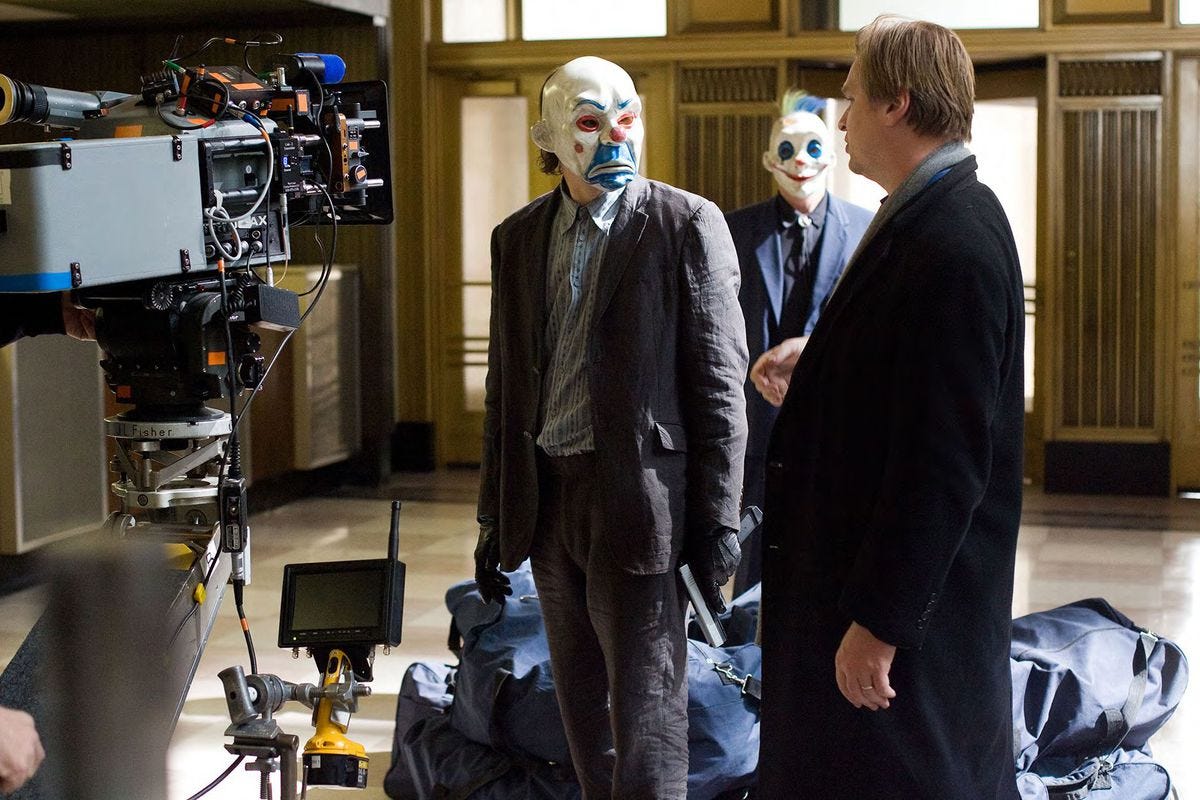
IMAX has been around for decades, but Christopher Nolan was the person who decided to shoot a major motion picture in that format.
It wasn’t, however, the first time that IMAX was used on a Nolan film. On Batman Begins, visual effects supervisor Janek Sirrs got some IMAX shots of the Chicago landscape to use later as CGI background plates, as the high-resolution image quality and flexibility offered by the format gave his team the option of reframing effects shots as needed. On Nolan’s next film, The Prestige, he tested it out on a visual effect to get an idea of how IMAX worked, confiding in cinematographer Wally Pfister that this was meant to be a test for shooting some scenes on The Dark Knight with IMAX.
The reason IMAX cameras hadn’t been used in a film before was for practical reasons: they were large, cumbersome, and noisy. Nolan knew it wouldn’t work for scenes with dialogue, forget it. But for the action sequences? If astronauts in space and Mount Everest climbers could shoot footage in more dangerous environments with IMAX cameras, then shooting on location in Chicago ought to be doable.
And he would shoot the film’s opening scene with it.
Nolan has developed a reputation as a director with a singular artistic style who also gets butts in seats. I think it’s partly because he also thinks beyond the film and how it will be seen, possibly born out of his days as an independent filmmaker trying to get as many people as he can to watch his films. That’s why he thought about what the teaser trailer for Batman Begins would look like even before he started writing a script: he’s thinking about ways to get his film marketed. This time, he went beyond thinking about a teaser trailer: he envisioned a self-contained prologue featuring the Joker carrying out an ingenious bank heist; it’d be similar to a James Bond pre-titles sequence, one that could stand on its own AND be released early to create buzz for the film.
Shooting the prologue in IMAX came with multiple advantages:
From a marketing point of view, it’s a unique sell.
From a visual point of view, it immediately sets itself apart from Batman Begins and declares itself to be a different kind of Batman film.
From a practical point of view, it allowed Nolan and his team to figure out whether it was possible to film motion pictures with IMAX cameras. If it didn’t work, they could simply go back to film stock and reshoot the prologue without having wasted a lot of money.
Still, Warner Bros. executives were “petrified” about the costs of shooting on IMAX, which was four times the price of regular 35mm stock and processing. Remember, Nolan was still THE Nolan as he is known now.
So Pfister ran the numbers and did his homework; before committing, he had to see if it was possible and affordable to shoot in IMAX. While Nolan read up on the IMAX technical stuff, Pfister spent three months learning the basics. He sent two of his camera assistants and a camera operator to Toronto (the headquarters and birthplace of IMAX) to study the system. They gathered all their information and research and took it to Warner Bros. to explain how he’d do it. The pitch must’ve been convincing because Warner Bros. gave Nolan and Pfister approval to go ahead.
As a result, principal photography began with filming the prologue itself before shooting anything else. That week became “IMAX School” for all involved, learning what it was like to actually to shoot with IMAX cameras. Despite all their prep, they still had to see if the dailies turned out well; if not, they’d abandon shooting in IMAX and shoot normally.
It worked. Everyone was happy, and Christopher Nolan introduced, almost single-handedly, the idea of shooting films in IMAX— twenty years later, after shooting a handful of scenes in IMAX, Nolan would become the first director to shoot an entire film with IMAX 70mm film cameras. Brady Corbet would do something similar with The Brutalist, reviving VistaVision as a format worth shooting feature films on— Paul Thomas Anderson shot One Battle After Another in it, as did Emerald Fennell for some scenes for Wuthering Heights (2026).
If the tools allow you to create a better film experience, use it! Or, you know, shoot it in IMAX. That works, too— it’s what Ryan Coogler did for Sinners and it was glorious.
Lesson #7: Clever Marketing Gets More People Curious To Watch Your Film
It’s not enough to slap the film’s poster on a billboard or take out ads in a magazine anymore because that world has long passed— for better or worse. In fact, it’s DEFINITELY NOT ENOUGH to rely on the familiarity of IP or brands anymore, either.
Look at what happened at the 2026 box office so far: seemingly “safe” bets like Star Wars: The Mandalorian and Grogu (Star Wars brand), Supergirl (DC Comics brand), and Masters of the Universe (popular 80s brand) disappointed; while riskier bets like Project Hail Mary, Michael, Obsession, and Backrooms performed much better.6
No. Today, with attention divided between more entertainment options than ever, films have to convince audiences to turn up to watch.
And Nolan is aware of this fact. In fact, going all the way back to Memento, he has used the early web to help promote interest in his films. For that film, Jonathan Nolan himself designed the film’s official website, providing clues and hints to the story without giving away anything crucial, such as a newspaper clipping about Leonard’s murder of Teddy— clicking on highlighted words in the article would lead to more material about the film, such as Leonard’s notes, photographs, and even police reports.
With the Internet becoming a more prominent feature in people’s lives (oh the horror!) and this time with the full backing of Warner Bros.’s coffers, the marketing team leaned heavily into digital marketing and other tactics to drum up interest in The Dark Knight. Once again, Jonathan Nolan got involved, as he and associate producer Jordan Goldberg began the first stages of marketing using presidential campaign–quality political polling to target over eleven million people in over seventy countries to get the word out— a move that The Los Angeles Times called “one of the most interactive movie campaigns ever hatched by Hollywood”.
One of the primary reasons for the early promotional push was to squash the negativity surrounding Heath Ledger’s casting of the Joker7. At San Diego Comic Con, “Jokerized” dollars were scattered around in a scavenger hunt with clues that led to a vantage point where a plane would sky-write a phone number; when people dialed the number, callers would be issued an invitation to join the Joker’s army.
Meanwhile, cards at comic-book stores led to a “Harvey Dent for District Attorney” website. When pixels were erased on the site, users were treated to the “Joker reveal”— the first public image of Heath Ledger as the Joker.
Harvey Dent also became part of the promotional campaign. A fake news site, modeled on the Drudge Report, peddled fake news about the election. (Some fans even went out on the street to support Harvey Dent—a fictional candidate running for a fictional position in a fake election in a city that didn’t exist). When “election time” came, voter-registration cards were sent out in the mail; a direct-action group was created dedicated to supporting Batman through pizza deliveries. Inside the box, people found a Batman mask, propaganda, and directions to an “underground” forum on the Internet, “Citizens for Batman”; they were organizing to meet in Chicago and New York to watch the Bat Signal light up the city skyline.
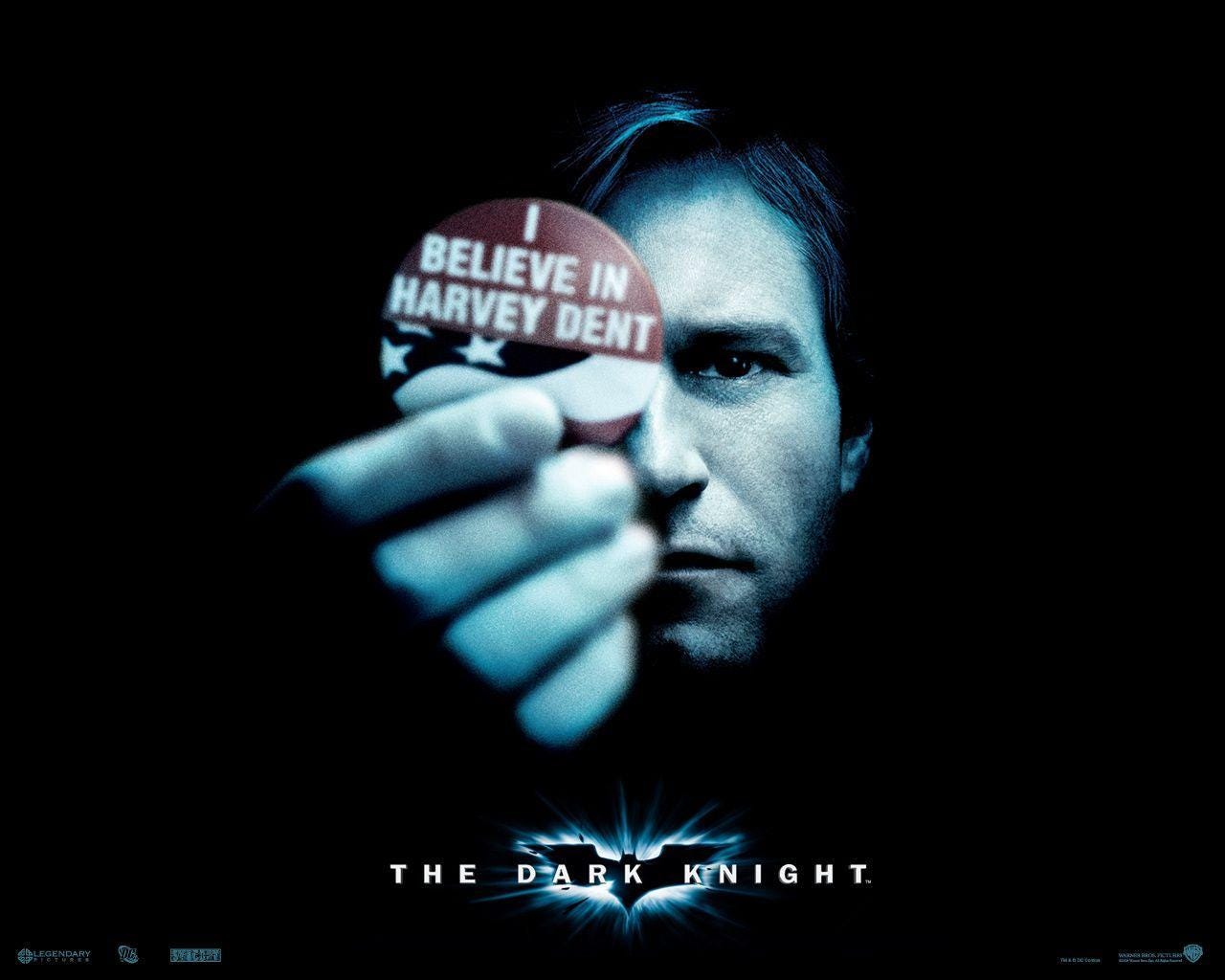
It didn’t hurt that these tactics also coincided with the 2008 U.S. Presidential elections, which tied into the film’s themes. It also didn’t hurt that this was the same time that people were congregating on the then-new platforms of Reddit, Tumblr, and Twitter, where many of the film’s lines—especially the Joker’s—became fodder for memes and remixes. In The Nolan Variations: The Movies, Mysteries, and Marvels of Christopher Nolan, Tom Shone describes:
An early viral ad featuring Heath Ledger’s Joker scrawled with the line “Why so serious?” was endlessly remixed, with cats, babies, Miley Cyrus, Al Gore, and then-presidential candidate Obama all given the “Joker treatment.” Left-wing bloggers cried foul; right-wing bloggers claimed credit. In The Wall Street Journal, novelist Andrew Klavan penned an op-ed, arguing that the film was “a paean of praise to the fortitude and moral courage that has been shown by George W. Bush in this time of terror.” Others on the Left embraced what they saw as the film’s stance against Bush and Cheney’s warrantless surveillance and torture tactics, and the decision of companies like Verizon, AT&T, and Google to turn over more than 1.3 million law-enforcement requests each year to the National Security Agency’s two-billion-dollar surveillance center.
But the film’s biggest publicity boost was both the unexpected and worst one: the tragic and untimely death of Heath Ledger, which ignited interest in the actor’s penultimate role8; his brilliant performance only brought audiences in droves— ultimately, The Dark Knight became the highest-grossing film of 2008, running for a staggering nine months (which seems like a fantasy nowadays), with reissues of the film pushing it past $1 billion, making it the first superhero film to do so9. Its snub for a Best Picture Oscar nomination provoked such an outcry that the Academy changed its rules for the first time to allow up to ten nominees in the category.
Nobody had expected The Dark Knight to perform so spectacularly, especially compared to the relatively modest gains of Batman Begins. Few would have expected a superhero film to be so critically acclaimed outside of fans; when Werner Herzog ran into Nolan after a screening, he congratulated him for making “the most significant film of the whole year”. Nolan thought he was joking but the German director replied, “No, no, no! This is a film of real substance. It doesn’t matter if it’s mainstream or not.”
It was a sequel, yes, but The Dark Knight is almost its own entity. Batman Begins was more of a classical superhero story; The Dark Knight is in new territory. The differences in cinematography, sound, score, and editing allowed Nolan to channel his artistic vision fully into the sequel in a way that he couldn’t with Batman Begins. It is also the one film of his that Nolan would agree is “cold”:
Compared to Batman Begins, The Dark Knight is a cruel, cold film. People talk about my films as being cold, and that’s really the only one where I see that, because the Joker is such an engine driving that film in such awful ways. That’s all the film is, a relentless series of horrible situations contrived by the Joker, and that was always the intent. There was nothing accidental about that. I pitched it in the studio as “It’s a white-knuckle ride—it’s just this descent.”
The Dark Knight is the film that really allowed Christopher Nolan to flex his artistic choices and visions within an established IP no less, and still made it his own. It’s a tentpole feature, yes; but it’s also very much a Nolan film, that addresses themes of surveillance, escalation, and chaos that preoccupies him. It is a personal blockbuster in every sense of the word. And when he proved that he could repeat it, his ascent into the club of A-list film directors only skyrocketed from there on out…
Inception Origins: How And Why The Film Cemented Christopher Nolan's Reputation

With The Odyssey, Christopher Nolan will have made a total of 13 feature films in his career thus far. Out of which:
Thanks for reading! If you liked this essay, you can sign up here for more issues. If you’d like to support Three Left Feet Media, share this newsletter with a fellow film lover you think would appreciate it.
Long live the movies!
D.L. Holmes
In that comic, Joker tries to accomplish this by shooting Barbara Gordon and kidnapping James Gordon and trying to drive him mad. Mercifully, The Dark Knight only borrowed this element figuratively by having the Joker corrupt Harvey Dent.
The Joker’s bank heist with him and the crew wearing clown masks was a nod to another Stanley Kubrick film, The Killing.
Which is about 4 hours long, by the way, and not widely available.
Who made uncredited contributions to Batman Begins.
Production designer Nathan Crowley once again designed a prototype in Nolan’s garage—as he had for the Tumbler— using a series of kit-bashed models.
When it comes to Obsession and Backrooms, it helps that both films did not cost as much to make as tentpole features.
For those of you who weren’t around in 2007-2008, this might surprise you but people HATED the idea of Heath Ledger as the Joker! No, for real, it was bad.
Ledger’s proper final film was in The Imaginarium of Doctor Parnassus for Terry Gilliam; but since he only shot part of his scenes, the character was rewritten to be played separately by Johnny Depp, Jude Law, and Colin Farrell.
Again, this might come as a surprise to some people, but in 2008-2009, the only films to have made more than $1 billion at the box office were Titanic, The Lord of the Rings: The Return of the King, and Pirates of the Caribbean: Dead Man’s Chest. That meant The Dark Knight was only the fourth film to cross the $1-billion mark. Today, there’s a preposterous FIFTY films on the list AT LEAST… and counting.